

Why One Houston Homeowner Pays 4x More Than Their 'Higher Risk' Neighbor

A Data-Driven Analysis of 40 Houston Properties

THE SITUATION

Two Houston homeowners. Both required to carry flood insurance. Both came to us looking for answers.

Homeowner A:

  • Location: Southeast Houston (77089)
  • Flood Zone: X (labeled "low-to-moderate risk")
  • Lender requirement: Optional, but chose to purchase
  • Assumption: "I'm in Zone X, so it should be cheap"

Homeowner B:

  • Location: Kingwood (77345)
  • Flood Zone: AE (labeled "high risk")
  • Lender requirement: Mandatory
  • Assumption: "I'm in a flood zone, so it's going to be expensive"

Both homeowners had the same question:

"How much should I actually be paying for flood insurance?"

THE PROBLEM

Both homeowners had been told the same story most Houston homeowners hear:

  • Zone AE = high risk = expensive flood insurance

  • Zone X = low risk = cheap flood insurance (if you need it at all)

This made sense to them. It's what their real estate agent said. It's what their lender implied. It's what they read online.

But when we pulled quotes, the numbers didn't match the story.

Frustrated

THE DISCOVERY

Homeowner A (Zone X - Southeast Houston):

NFIP Premium: $1,666/year

We ran the numbers three times. Same result. A "low risk" Zone X property with a premium higher than most Zone AE properties in our database.

Homeowner B (Zone AE - Kingwood):

NFIP Premium: $432/year

A "high risk" Zone AE property — the kind lenders require coverage for — paying less than a third of what the Zone X homeowner was quoted.

The "low risk" homeowner was paying nearly 4x more than the "high risk" homeowner.

Discovery

THE ANALYSIS

We dug into the data to understand why. Here's what we found:

Homeowner A — Why So High?

Factor Finding
Flood Zone X (moderate risk on paper)
Proximity to Flood Source Close to drainage channels that overflowed during Harvey
Elevation Sits lower than surrounding properties
Flood History Neighborhood experienced significant flooding in 2017
Risk Rating 2.0 Impact FEMA's new model captures historical flood events — not just zone lines


Homeowner B — Why So Low?

Factor Finding
Flood Zone AE (high risk on paper)
Proximity to Flood Source Near San Jacinto River tributary
Elevation Property sits 2+ feet above base flood elevation
Flood History Specific property did not flood during Harvey
Risk Rating 2.0 Impact Elevation advantage significantly reduces calculated risk


The insight: Under FEMA's Risk Rating 2.0 (implemented October 2021), flood zone is just ONE factor. The system now evaluates:

  • Distance to flood source (bayou, river, coast)

  • Elevation relative to that source

  • Type of flood risk (river overflow, storm surge, heavy rainfall)

  • Historical flood frequency at your specific location

  • Building characteristics (foundation type, first floor height)

Zone X doesn't mean low risk. Zone AE doesn't mean high cost. Your specific property determines your premium.

THE BROADER PATTERN

This wasn't an anomaly. We analyzed all 40 Houston properties in our database and found the same pattern:

Zone X Properties (17 total):

Neighborhood
Zip Code
Premium
Cypress 77041 $301
Greenspoint area 77014 $341
Alief 77072 $505
River Oaks area 77019 $531
Third Ward 77021 $629
Meyerland 77096 $939
Memorial 77024 $1,251
Southeast Houston 77089 $1,666


Zone X Range: $301 — $1,666

That's a 5.5x spread within properties all classified as "lower risk."

Zone AE Properties (14 total):

Neighborhood
Zip Code
Premium
Kingwood 77345 $432
Meyerland 77096 $493
Fondren Southwest 77099 $707
Jersey Village area 77040 $1,327
Meyerland 77096 $2,796
Memorial 77024 $3,324
Clear Lake 77059 $3,658


Zone AE Range: $432 — $3,658

That's an 8.5x spread within properties all classified as "high risk."

Key Finding: 7 of our Zone X properties pay MORE than the lowest-priced Zone AE property.

THE SOLUTION

For both homeowners, we followed our standard process:

Step 1: Understand the Property's Actual Risk

We pulled flood zone data, checked for elevation certificates, and reviewed FEMA's flood history for each address.

Step 2: Quote Both NFIP and Private

We ran quotes through NFIP (via Wright, our Write-Your-Own carrier) and multiple private flood carriers.

Step 3: Compare Coverage — Not Just Price

We looked at:

  • Premium

  • Coverage limits (building and contents)

  • Deductible options

  • Replacement cost vs. actual cash value

  • Additional living expenses

  • Waiting period

Step 4: Present Options and Recommend

We showed both homeowners their options side-by-side and explained the trade-offs.

Zone X - Southeast Houston

HOMEOWNER A OUTCOME

The Problem: $1,666/year NFIP premium for a "low risk" property

What We Found:

Option Premium Building Coverage Contents ALE
NFIP (Wright) $1,666 $250,000 $100,000 No
Private Carrier A $892 $250,000 $100,000 Yes
Private Carrier B $1,104 $300,000 $150,000 Yes

Recommendation: Private Carrier A

Result:

  • Annual savings: $774/year

  • Better coverage: Added Additional Living Expenses

  • 10-year savings: $7,740

Why Private Was Cheaper:

Private carriers use different risk models than FEMA. In this case, the private carrier weighted the property's construction quality and specific elevation data more favorably than FEMA's Risk Rating 2.0 model.

Zone AE - Kingwood

HOMEOWNER B OUTCOME

The Situation: $432/year NFIP premium — already competitive

What We Found:

Option Premium Building Coverage Contents ALE
NFIP (Wright) $432 $250,000 $100,000 No
Private Carrier A $487 $250,000 $100,000 Yes
Private Carrier B $512 $350,000 $150,000 Yes

Recommendation: NFIP (Wright)

Result:

  • Stayed with NFIP at $432/year

  • Lowest premium available

  • Adequate coverage for property value

Why NFIP Was the Right Choice:

For this property, NFIP's Risk Rating 2.0 model actually produced a favorable rate due to the elevation advantage. Private carriers couldn't beat it on price. The homeowner's property value was under $250,000, so NFIP's coverage limits were sufficient.

THE KEY INSIGHT

There is no universally "better" option between NFIP and private flood insurance.

It depends entirely on YOUR property:
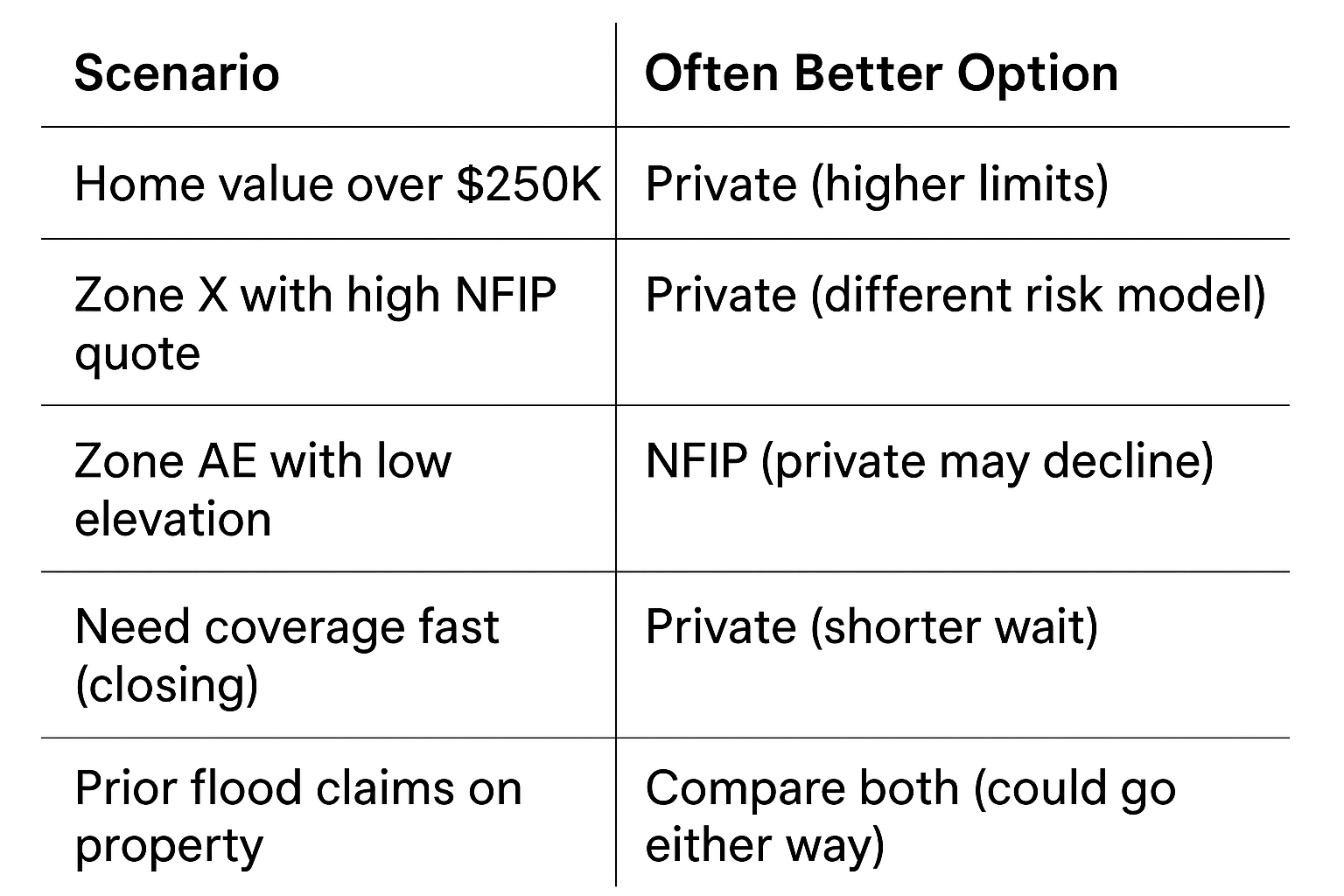
Houston Scenario Table

WHAT THIS MEANS FOR HOUSTON HOMEOWNERS

THE DATA SUMMARY

40 Houston Properties Analyzed

Metric Value
Total properties 40
Zone X properties 17
Zone AE properties 14
Zone A properties 1
Unspecified zone 8
Lowest premium (Zone X) $301
Highest premium (Zone X) $1,666
Lowest premium (Zone AE) $432
Highest premium (Zone AE) $3,658
Zip codes represented 26

Premium Distribution:

Premium Range Count
Under $500 8
$500 - $999 14
$1,000 - $1,999 6
$2,000 - $2,999 2
$3,000+ 3

Carrier Distribution:

Carrier Count
Wright (NFIP WYO) 32
NFIP Direct 3
TFIA (Private) 1
Argenia (Private) 1
Other/Unspecified 3

NEIGHBORHOOD INSIGHTS

Highest Premium Neighborhoods:

Neighborhood Zip Zone Premium Range Why
Clear Lake 77059 AE $3,658+ Storm surge exposure from Galveston Bay
Memorial 77024 AE $3,324 Buffalo Bayou corridor, low elevation
Meyerland 77096 AE Up to $2,796 Brays Bayou proximity, flood history

Lowest Premium Neighborhoods:

Neighborhood Zip Zone Premium Range Why
Cypress 77041 X $301+ Distance from major flood sources
Greenspoint 77014 X $341+ Lower flood frequency
Kingwood 77345 AE $432+ Elevation advantage despite AE zone

Most Premium Variation:

Neighborhood Zip Zone Mix Premium Range Spread
Meyerland 77096 X and AE $493 - $2,796 5.7x
Memorial 77024 X and AE $1,251 - $3,324 2.7x
THE FRAMEWORK

HOW WE APPROACH EVERY HOUSTON PROPERTY

Step 1

Data Gathering

  • Flood zone determination
  • Elevation certificate (if available)
  • Property characteristics
  • Flood history review
Data Gathering
Step 2

NFIP Quote

  • Through our Write-Your-Own carrier (Wright)
  • Risk Rating 2.0 pricing
  • Standard coverage options
NFIP Quote
Step 3

Private Market Quote

  • Multiple carriers when available
  • Compare coverage enhancements
  • Check availability for specific address

Private Market
Step 4

Side-by-Side Analysis

  • Premium comparison
  • Coverage comparison
  • Identify gaps or advantages
  • Factor in waiting periods
Side-by-Side Analysis
Step 5

Recommendation

  • Based on property specifics
  • Homeowner's budget and needs
  • Lender requirements
  • Long-term cost considerations
Recommendation
Step 6

Implementation

  • Bind coverage
  • Ensure lender compliance
  • Document for closing (if applicable)
  • Set renewal reminder
Implementation

WHAT WE LEARNED FROM 40 HOUSTON PROPERTIES

Flood zone is not destiny

Zone X homeowners can pay more than Zone AE homeowners. Zone AE homeowners can find affordable coverage. The zone classification is a starting point — not a verdict.

Risk Rating 2.0 changed everything

FEMA's new pricing model looks at your specific property. Two neighbors can pay wildly different premiums based on elevation, distance to water, and flood history.

Comparing NFIP and private is essential

Neither is universally better. Some properties save hundreds with private carriers. Others are best served by NFIP. The only way to know is to quote both.

Houston neighborhoods vary dramatically

Clear Lake properties face storm surge exposure. Memorial properties deal with Buffalo Bayou elevation issues. Kingwood properties often have elevation advantages. Your neighborhood gives context — but your address determines your rate.

Most homeowners don't know their options

The majority of Houston homeowners we talk to have never been quoted both NFIP and private. They accepted whatever their agent quoted first. That's often leaving money on the table — or leaving coverage gaps unaddressed.

ABOUT THIS CASE STUDY

Data Source: 40 Houston-area flood insurance policies written by The Flood Insurance Guru

Time Period: Policies active 2024-2025

Methodology: All premiums reflect NFIP Risk Rating 2.0 pricing. Private carrier quotes obtained where available. Property identifying information (names, specific addresses) removed for privacy.

Limitations: This data represents our book of business and may not reflect Houston-wide averages. Premium ranges are based on actual policies and may not represent the full range of possible outcomes.

READY TO SEE WHERE YOUR PROPERTY FALLS?

Here's what we'll do:

  1. Pull your property's flood zone and risk data

  2. Quote both NFIP and private options

  3. Show you side-by-side comparison

  4. Explain exactly why your premium is what it is

  5. Help you pick the coverage that actually fits

No pressure. No obligation. Just the information you need.

Chris