

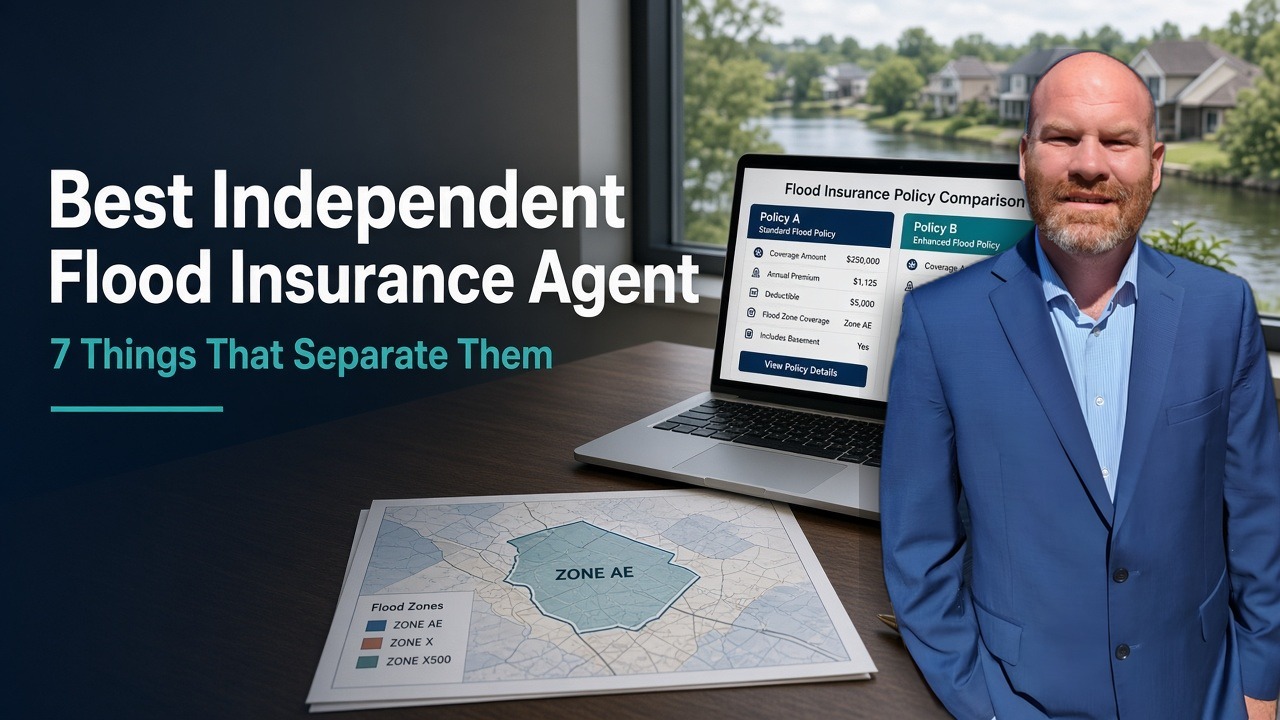
Short answer: The best independent flood insurance agent does more than shop several carriers. They know, carrier by carrier, how each one handles claims, renewals, non-renewals, and rate increases, and how each one pays out on a claim. Shopping multiple carriers is the minimum. Knowing how each carrier behaves after you buy is what separates the best agents from the rest.
Watch: Chris walks through how to pick the right flood insurance agent and the five questions to ask before you choose.
You need flood insurance, maybe because your lender requires it or your NFIP renewal just jumped. Almost every agent will tell you they "shop the market." I learned the hard way that it isn't enough. When I bought a house in a flood zone more than a decade ago, I got the wrong information from my insurance agent, and it almost cost me my house. I was underinsured; I paid thousands of dollars in premiums I didn't have to, and I didn't have the right coverage.
"Shopping flood carriers is not enough." — Chris Greene, The Flood Insurance Guru
Price is easy to compare. What happens after you sign is harder: at claim time, at renewal, and when rates go up. Here's what to look for, and the questions to ask any agent, me included.
1. The minimum bar: they quote the NFIP and multiple private carriers
Any independent flood agent should compare NFIP and private options side by side. Treat that as table stakes, not a reason to hire them. NFIP residential building coverage tops out at $250,000 and contents at $100,000. If your home would cost $750,000 to rebuild, you may need a private policy, or a $250,000 NFIP policy plus a $500,000 excess policy on top.
Questions to ask your agent:
- Which NFIP and private options did you compare for my property, and why did you recommend this one?
- Would an excess policy over the NFIP make sense for my rebuild cost?
- How do the NFIP and private flood insurance differ for my property?
Related: the NFIP coverage gaps every buyer should know about.
2. They know how each carrier handles claims
The best agent knows how each carrier actually behaves when a claim comes in, not just what the brochure says. The policy only matters on the day you file. An agent who has worked a large number of flood claims has seen how the process plays out from one carrier to the next.
Questions to ask your agent:
- How many flood claims have you personally handled?
- What does the claims process look like with this carrier, and what's your role when I file?
- How long do I have to file a claim, and what documentation (photos, videos) will I need?
As I put it in the video, insurance is no good if you don't have what you need at claim time. We recently spoke with a property owner who lost $40,000 on a flood claim because one piece of information wasn't disclosed.
3. They know how each carrier pays out: ACV, repair, or rebuild
Ask how a claim would actually be paid: actual cash value, cost to repair, or full replacement cost. For example, NFIP pays actual cash value on contents, while some private policies pay replacement cost. Deductibles matter too. NFIP has separate building and contents deductibles, so choosing $2,000 on each could mean $4,000 out of pocket. Some private policies include additional living expenses/loss of use. The details vary by carrier and policy form.
Questions to ask your agent:
- If my home flooded tomorrow, how would this policy pay on the building and on my contents?
- How many deductibles apply, and what's my real out-of-pocket cost?
- Does this policy include additional living expenses or loss of use?
- Am I insured to replacement cost, or just a stated amount that depreciation will shrink?
Here's why it matters. When a lakefront property flooded in 2018, one owner had a private policy with temporary living expense coverage, which helped her for six months. Her neighbors with NFIP policies had nothing for that. (Coverage depends on the carrier and policy, and not every private policy includes it.)
4. They know what renewals look like with each carrier
A great price in year one means little if renewal brings a surprise. The best agent knows what renewals have typically looked like with each carrier, so you can plan for more than the first year.
Questions to ask your agent:
- What have renewals looked like for clients with this carrier?
- Will you review my options again before each renewal?
5. They know which carriers non-renew, and when
Ask whether the carrier has a history of non-renewing policies, and what your plan is if it happens. If you're lender-required and get non-renewed, you need replacement coverage in place without a gap. An experienced agent knows that and plans for it ahead of time.
For comparison, NFIP policies generally renew automatically as long as your community participates in the program. Non-renewals are rare and usually come down to documentation. With private carriers, it can depend on the carrier's contracts and on changes to its flood risk scoring in your area. A good agent also tells you whether carriers are pulling back from your area.
Questions to ask your agent:
- Are carriers pulling out of my area?
- Have you seen this carrier non-renew policies like mine? Under what circumstances?
- If I'm non-renewed, what's the backup plan and how fast can we move?
6. They know how each carrier handles rate increases, NFIP included
Your agent should be able to explain where your rate is likely headed, not just today's number. On NFIP residential renewals, we consistently see increases of about 18% a year for primary residences and about 25% for non-primary residences. Under Risk Rating 2.0, your flood zone no longer sets your NFIP rate. Property factors do, such as distance to water, elevation, and rebuild cost. A good agent also knows when an elevation certificate or a LOMA (Letter of Map Amendment) might help.
The NFIP's statutory cap on annual renewal increases (up to 18% for primary residences) doesn't apply to private carriers. That's why you need an agent who knows how each one has actually handled renewals. Saving $100 this year could cost you $1,000 next year, so ask about long-term rate stability, not just today's price. Also ask for your flood risk score: the chance your property floods over the next 30 years, scored 0 to 100. It's a good signal of where premiums may be headed, and it changes over time.
Questions to ask your agent:
- What's my flood risk score, and will you update me on it at renewal?
- How have this carrier's rates changed at renewal, and what's driving my premium?
- Would an elevation certificate or a LOMA help in my situation?
7. They know lenders, closings, and waiting periods
The best agent keeps the flood policy from delaying your closing. NFIP policies usually have a 30-day waiting period, but it's waived when the coverage is tied to a loan closing. Private flood waiting periods are often about 3 to 10 days. Your agent should also confirm the policy meets your lender's requirements and hold a license in your state.
Questions to ask your agent:
- Will this policy satisfy my lender, and when will it be bound?
- Are you licensed in my state?
- If I'm buying, can I assume the seller's existing flood policy?
- Is my lender likely to accept a private flood policy for my loan type?
- Will you tell me if my flood zone is changing, or whether my property could qualify for a flood zone change?
Online flood quote sites vs. an education-first flood specialist
Online flood quote platforms can be a fast way to see prices. A flood specialist adds context on how each carrier behaves after you buy. Here are a few examples of online flood insurance shopping and quoting services, which I've described as national flood insurance brokerages that specialize in flood insurance. Here's how they describe themselves on their own homepages (as of October 2026):
- BetterFlood.com compares NFIP and private flood options and gives one recommendation, reviewed by a licensed staff member.
- FloodSimple.com is a flood insurance agency with an instant online price tool. It says it represents eight flood insurance companies.
- FloodPrice.com has an online quote tool that shows NFIP and private flood quotes side by side.
When an online quote site may be all you need: You want a fast price comparison, your property is simple, and you're comfortable reading the policy terms yourself.
When a specialist matters more: You're buying in an inland Zone A/AE and your lender requires coverage, your rebuild cost is above NFIP limits, you're facing a big Risk Rating 2.0 increase, you've been non-renewed, or you want to know how a carrier is likely to handle your claim, your renewals, and your rate increases. These questions are the backbone of this article, and a quoting screen can't fully answer them.
At FloodInsuranceGuru.com, education comes first. For almost a decade, we've published weekly YouTube videos and weekly articles. We use real-world examples to help people understand their flood risk, what flood insurance costs, and how flood zones work. Whichever route you choose, ask the questions in this guide.
Why I know this: Flood Insurance Guru
You can't learn how carriers behave at claim time and at renewal from a quoting screen. You learn it by placing policies and working claims, year after year. I built Flood Insurance Guru to be the agent I wish I'd had: - In insurance since 2009, focused on flood - 20,000+ flood policies placed and 10,000+ claims handled - Licensed in all 50 states - We compare NFIP and private flood options so you can see the tradeoffs before you choose - During the 43-day NFIP lapse in 2025, when new NFIP policies couldn't be written, I worked with clients personally to keep their closings and their coverage on track
Your 3-step plan
- Request a quote at floodinsuranceguru.com/get-a-flood-quote. You can also start with a free flood zone check.
- Talk with me or one of our flood risk advisors about your NFIP and private options.
- Finalize the right policy, sized to your actual rebuild cost and your closing date.
Don't let the wrong advice put your home at risk the way it almost did mine.

FAQ
What makes the best independent flood insurance agent?
More than shopping carriers. The best agents know how each carrier handles claims, renewals, non-renewals, and rate increases, and how each pays out (actual cash value vs. replacement cost).
What is an independent flood insurance agent?
An independent flood insurance agent isn't tied to one company. They can quote the NFIP and several private flood carriers, so you can compare price and coverage.
Is NFIP or private flood insurance better?
It depends on your property. NFIP caps residential building coverage at $250,000 and contents at $100,000, and it pays actual cash value on contents. Private flood can offer higher limits, replacement cost on contents, and shorter waiting periods. A specialist should compare both for you.
How long is the waiting period for flood insurance?
NFIP policies generally have a 30-day waiting period, but it's waived when the coverage is tied to a loan closing. Private flood waiting periods are often about 3 to 10 days.
Does my flood zone determine my NFIP rate?
No. Under Risk Rating 2.0, NFIP rates are based on property-specific factors such as distance to water, elevation, and rebuild cost, not your flood zone alone.
How much are NFIP rates going up?
On residential renewals, we're consistently seeing increases of about 18% a year for primary residences and about 25% for non-primary residences.
What if my home costs more than $250,000 to rebuild?
You can buy a private flood policy for the full replacement cost, or add an excess flood policy on top of your NFIP policy to cover the gap.
