

Did your mortgage payment suddenly jump by $200 to $300 a month without warning?
A higher mortgage payment can reflect insurance costs, property taxes, an escrow shortage, or a loan payment change. Review your escrow statement and loan terms to identify the cause before assuming flood insurance explains the entire increase.
Here is how to separate a higher flood insurance bill from shortage repayment and decide what to ask your mortgage servicer.
What Really Caused Your Escrow Shortage
Your payment may include both the projected cost of future bills and repayment of an existing shortage.
Mortgage servicers use escrow accounts to pay covered taxes and insurance. If actual bills exceed projected amounts, the next analysis may identify a shortage. The timing and amount depend on disbursements, deposits, and the account balance.
Illustrative example, not a documented customer case:
-
Your annual insurance bill increased by $600; this is an arithmetic example, not an assumed NFIP renewal increase
-
Your servicer paid the higher bill from escrow
-
You continued making the old mortgage payment
-
For this example, assume the analysis identifies a $600 shortage
The statement should show projected bills and how any shortage will be handled.
Why the Payment Increase Feels So Extreme
Your analysis may include:
-
Recovers the shortage from last year
-
Funds the higher insurance cost for the coming year
-
Maintains an allowed cushion; for covered accounts, federal rules generally limit it to two months of escrow payments, and a lower limit may apply
In this simplified example, $600 more per year adds $50 per month for future insurance bills. Repaying a separate $600 shortage over 12 months adds another $50 per month, for a $100 monthly increase before any other adjustments. A $200–$300 increase would require additional amounts or different assumptions.
Ask About an Off-Cycle Escrow Analysis
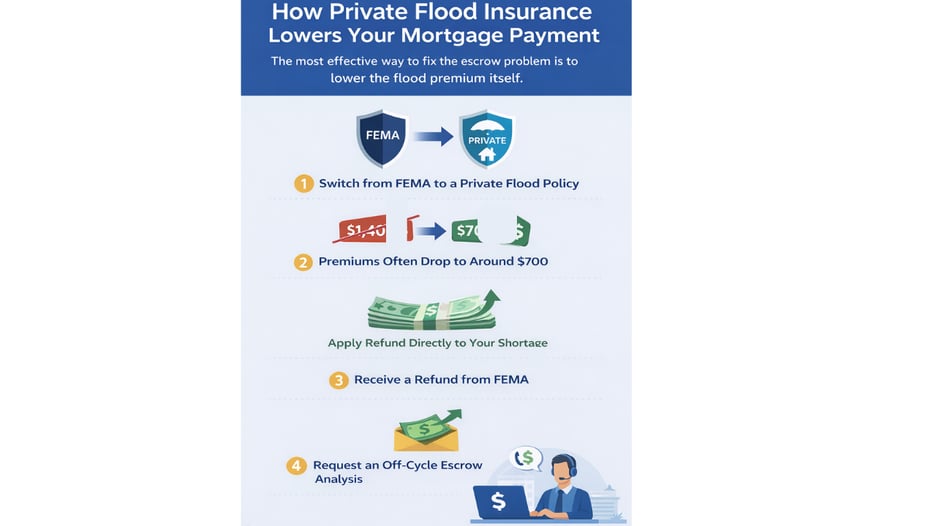
Ask your servicer whether an earlier analysis is available and what documentation it needs.
If your insurance changed or you suspect an increase, call your mortgage servicer and say this exact phrase:
"I need to request an off-cycle escrow analysis."
A request does not force an immediate recalculation. Regulation X permits analyses at other times during the year; confirm your servicer’s process and the effective date of any payment change.
Why Timing Matters
After a policy change, ask the servicer to:
-
Confirm the new premium and payment instructions
-
Explain how refunds or remaining shortages will be handled
-
Confirm whether and when it will recalculate the payment
An escrow review changes accounting and payment timing. It does not itself reduce the insurance premium or erase a shortage.
Frequently Asked Questions
Why can my mortgage payment rise more than the insurance increase?
A payment can include both higher projected bills and shortage repayment. Check for tax changes and other adjustments too.
Can I request an escrow analysis at any time?
You can ask. An off-cycle review and its timing depend on the servicer and applicable rules; requesting one does not guarantee an immediate payment reduction.
Is private flood insurance always cheaper?
No. Compare actual quotes with matching coverage and deductibles. Rates and availability vary.
Will switching flood insurance automatically lower my mortgage payment?
Confirm the new bill with your servicer and ask when it will update your escrow payment. An existing shortage can offset some of the reduction.
Does an escrow review eliminate my shortage?
No. Ask the servicer to explain the calculation, repayment options, and how any insurance refund will be applied.
Review Your Renewal and Escrow Statement Together
Bring your renewal notice and escrow analysis so we can help compare the insurance portion of your costs. Request a flood insurance review, and ask your servicer to explain the mortgage payment calculation.

Source: CFPB Regulation X: escrow accounts. Related: understanding NFIP renewal increases.