

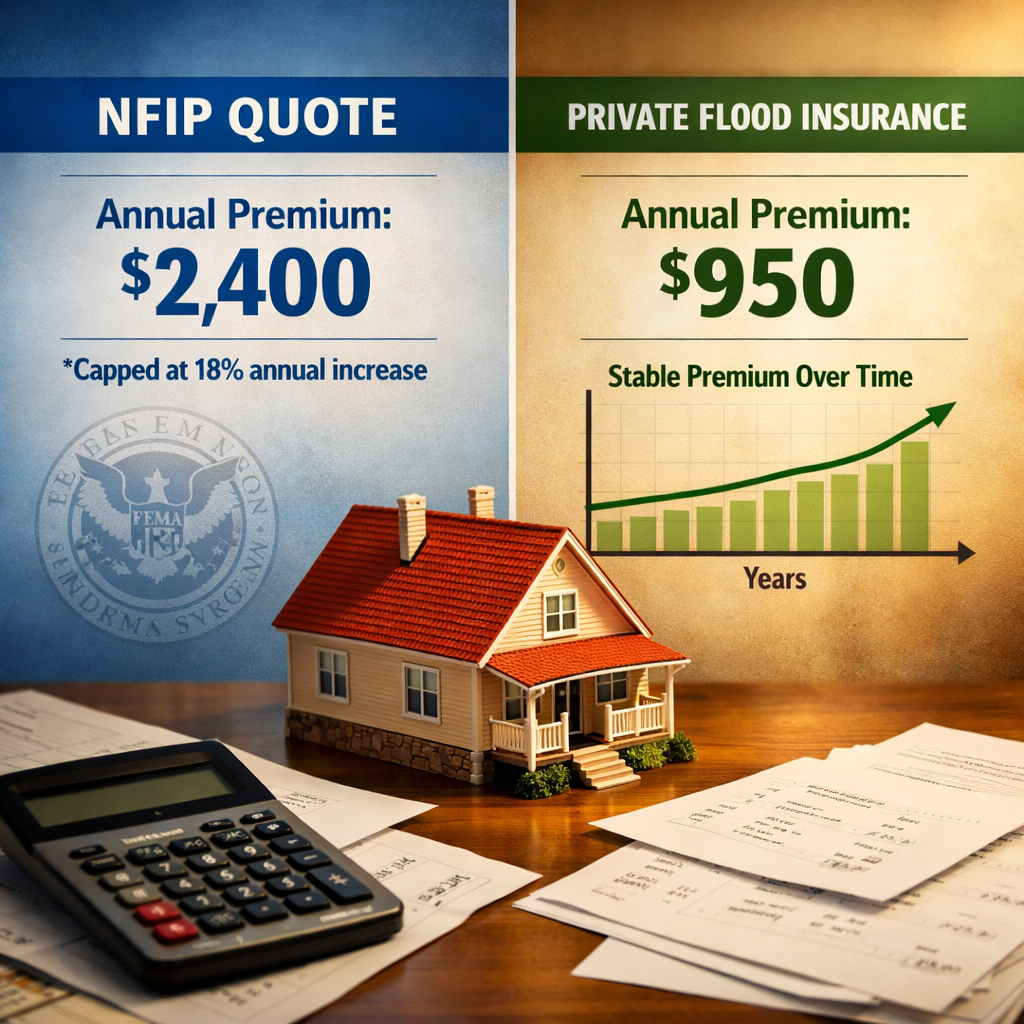
Comparing flood insurance options feels confusing when you're looking at renewal quotes side by side. You see one number from the National Flood Insurance Program (NFIP) and another from a private carrier—but which one will actually cost less over 5, 10, or even 15 years? Flood Insurance Guru helps Georgia homeowners answer that exact question by shopping multiple top-rated flood insurance carriers to find the best long-term value.
This guide walks you through how to evaluate private flood insurance versus NFIP policies based on premium stability, renewal changes, and total cost of ownership over multiple years. By the end, you'll have a repeatable framework for making a confident decision about your flood coverage.
Key Takeaways: Private Flood Insurance vs NFIP Cost Over Time in 2026
- NFIP premiums are capped at 18% annual increases, but Risk Rating 2.0 means many Georgia homeowners will see gradual climbs for years.
- Private flood insurance often starts lower and can remain stable if your property has favorable elevation and distance-to-water metrics.
- Flood Insurance Guru shops multiple carriers to help you find policies with the most predictable long-term premium behavior.
- Switching from NFIP to private can save money, but you may lose grandfathered rate protections—compare carefully before making changes.
- Building a multi-year cost model (3, 5, and 10 years) reveals which option truly costs less when renewals and rate increases are factored in.
What Is the Difference Between NFIP and Private Flood Insurance?
NFIP is the federal flood insurance program managed by FEMA. It offers standardized coverage with set limits: up to $250,000 for your building and $100,000 for contents. Every NFIP policy follows the same terms, regardless of which insurance company issues it.
Private flood insurance comes from non-government carriers who set their own coverage terms, limits, and pricing. This flexibility means private policies can offer higher coverage limits (sometimes exceeding $1 million), replacement cost coverage for contents, and additional protections like temporary living expenses.
The key distinction for long-term cost planning is how each option prices your risk and how those prices change at renewal time.
How Does FEMA's Risk Rating 2.0 Affect Your NFIP Premium Over Time?
Risk Rating 2.0 is FEMA's current pricing methodology for NFIP policies. Implemented in phases between October 2021 and April 2023, this system calculates your premium based on your property's individual flood risk rather than just your flood zone designation.
Key Factors in Risk Rating 2.0 Pricing
According to FEMA's official documentation, your NFIP premium under Risk Rating 2.0 depends on:
- Distance to flooding sources (coast, rivers, lakes)
- Ground elevation relative to the surrounding area
- Foundation type and first-floor height
- Building replacement cost
- Flood type exposure (storm surge, river overflow, heavy rainfall)
For Georgia homeowners, this means two houses in the same neighborhood can pay very different premiums. A home in Savannah's historic district might pay significantly more than a newer elevated home in the same ZIP code.
NFIP Annual Rate Caps and What They Mean for You
Federal law caps most NFIP annual premium increases at 18%. This sounds like protection, but it actually means your premium may climb year after year until it reaches the full risk-based rate FEMA has calculated for your property.
If your current premium is below the full risk rate, you'll see increases at renewal—possibly for many consecutive years. This "glide path" approach means your year-one savings could disappear by year five.
How Do Private Flood Insurance Premiums Change Over Time?
Private carriers use their own proprietary risk models and data sources to price policies. Unlike the NFIP’s standardized approach, private insurers compete for your business, which can work in your favor if your property has lower-risk characteristics. However, this flexibility comes with two critical trade-offs: no federal price caps and the possibility of non-renewal.
The Absence of Annual Rate Caps
While the NFIP has a statutory "glide path" that generally caps annual premium increases at 18%, private carriers are not bound by federal law. If a private insurer’s data shows an increased risk in your area, or if they experience high claim payouts across their entire portfolio, they can increase your premium significantly more than 18% in a single year.
Understanding the Risk of Non-Renewal
Because private companies are profit-driven entities, they constantly evaluate their "risk appetite." If a carrier decides that a specific coastal area or a neighborhood with frequent river flooding is no longer profitable, they may issue a non-renewal notice.
This means:
- The policy ends: You will need to shop for a new private carrier or return to the NFIP.
- Loss of "Grandfathering": If you leave the NFIP for a private policy and are later non-renewed, moving back to the NFIP will likely be at current "Risk Rating 2.0" prices, potentially resulting in the loss of any lower rates you previously locked in.
When Private Premiums Tend to Stay Stable
Despite these risks, private premiums often remain more stable than federal ones for properties that meet modern safety standards. You are more likely to see consistent pricing if your property has:
- Elevated first-floor height above the base flood elevation.
- Newer construction built to the latest regional building codes.
- Flood mitigation features, such as certified flood vents or improved drainage grading.
When Private Flood Insurance Stays Stable
Private premiums tend to remain more stable when your property has:
- Elevated first-floor height above base flood elevation
- Newer construction built to current building codes
- Greater distance from water sources
- Flood mitigation features like flood vents or proper grading
According to industry data from WalletGrower's 2026 analysis, private flood insurance is approximately 60% cheaper than NFIP for newer or elevated homes.
Potential Premium Volatility with Private Coverage
Private insurers are not bound by NFIP's 18% annual cap. This means your premium could increase more dramatically at renewal if the carrier reassesses your risk or if broader market conditions shift. Some private carriers have also chosen not to renew policies in certain high-risk areas.
This is why comparing just the first-year premium doesn't tell the full story. You need to model potential scenarios across multiple years.
How to Build a Multi-Year Cost Model for Flood Insurance
A multi-year cost model helps you see beyond the initial quote and understand the total cost of ownership. Here's a step-by-step approach you can follow.
Step 1: Gather Your Current Policy Details
Start by collecting your current flood insurance declaration page. Note your current premium, coverage limits, deductible, and any fees or surcharges. For NFIP policies, look for line items like the Reserve Fund Assessment and HFIAA surcharge.
Step 2: Request Quotes from Multiple Sources
Get renewal quotes from your current carrier and at least two or three private carriers. Make sure you're comparing equivalent coverage limits and deductibles—an apples-to-apples comparison is essential.
Step 3: Estimate Annual Increases
For NFIP, assume 10-18% annual increases if your current premium is below the full risk rate. Ask your agent whether your policy is currently subsidized or grandfathered, as this affects the trajectory.
For private carriers, ask about their historical renewal behavior. Some carriers have maintained stable rates for properties with consistent risk profiles, while others adjust more frequently.
Step 4: Calculate Total Cost Over 3, 5, and 10 Years
Create a simple spreadsheet with yearly premium estimates for each option. Sum the totals across your time horizon. This reveals which policy truly costs less when compounding increases are factored in.
For example, an NFIP policy starting at $1,200 with 15% annual increases would cost approximately $8,755 over five years. A private policy starting at $1,500 with 5% annual increases would cost approximately $8,288 over the same period—a savings of nearly $500 despite the higher initial premium.
What Happens to Your Premium If You Switch from NFIP to Private?
Switching flood insurance requires careful consideration of both short-term savings and long-term implications.
The End of Grandfathering vs. The Glide Path Program
It’s a common misconception that "Grandfathering" still protects your rates. Under FEMA’s Risk Rating 2.0, traditional grandfathering no longer exists. Instead, FEMA has implemented the Glide Path Program.
Instead of a massive, one-time jump to your "True Risk" rate, the Glide Path allows your premiums to increase incrementally over time.
How the Glide Path Works:
- 18% Annual Increases: For most primary residences, federal law caps annual premium increases at 18% (25% for non-primary or commercial properties) until you reach your full risk-based rate.
- The "Full Risk" Target: Your premium will continue to climb every single year until it matches the specific risk profile FEMA has calculated for your home.
- The Risk of Switching: If you leave the NFIP for a private policy, you effectively "exit" the glide path. If you ever try to return to the NFIP later, you won't restart where you left off—you will likely be hit with the Full Risk Rate immediately, which can be a massive financial shock.
Guide's Note: This is why I always tell homeowners: "Don't switch just to save $200 today if it means giving up a glide path that's keeping your rate $2,000 below its true cost."
When Switching Makes Financial Sense
Switching to private flood insurance often makes sense when:
- Your NFIP premium is not grandfathered or subsidized
- Private carriers are offering coverage at 20% or more below your NFIP renewal
- You need higher coverage limits than NFIP's $250,000 cap
- You want replacement cost coverage for contents
Flood Insurance Guru can help you evaluate whether switching aligns with your long-term financial goals by comparing options from multiple carriers side by side.
What Are the Coverage Differences That Affect Long-Term Value?
Premium cost is only part of the equation. Coverage differences can significantly affect your out-of-pocket costs if you ever file a claim.
NFIP Coverage Limitations
NFIP policies have standardized terms that include several notable limitations:
- Building coverage capped at $250,000
- Contents coverage capped at $100,000
- No coverage for basement contents (except essential equipment)
- No coverage for temporary living expenses
- Actual cash value settlement for contents (depreciation applies)
For Georgia homeowners with properties valued above $250,000, the NFIP cap could leave you with significant uninsured exposure.
Private Flood Insurance Coverage Advantages
Many private policies offer broader coverage terms:
- Building coverage up to $1 million or more
- Higher contents limits
- Replacement cost settlement (no depreciation)
- Additional living expenses if you must relocate during repairs
- Pool and deck coverage (often excluded by NFIP)
When modeling long-term costs, consider what you would pay out of pocket in a claim scenario under each policy type.
How Does Georgia's Flood Risk Affect Your Premium Trajectory?
Georgia's diverse geography creates varying flood risk profiles across the state. Understanding your specific risk helps predict how your premium might change over time.
Coastal Georgia Flood Insurance Costs
Coastal counties like Chatham (Savannah), Glynn (Brunswick/St. Simons), and Camden face the highest premiums due to storm surge and tidal flooding exposure. According to research from Blake Insurance Group, homeowners in these areas may see premiums ranging from $1,500 to $2,800 or more annually.
For coastal properties, private flood insurance may offer savings if your home is elevated and meets current building codes. However, availability can be limited in the highest-risk coastal zones.
Inland Georgia Flood Insurance Costs
Inland areas along Georgia's rivers—including the Chattahoochee (metro Atlanta), Flint (south Georgia), Ocmulgee (Macon), and Savannah River (Augusta)—face river overflow flooding risk. Premiums in these areas typically range from $800 to $1,500 annually.
Metro Atlanta has seen increasing urban flooding as development reduces natural drainage. Some previously low-risk areas have moved into higher rate categories, catching homeowners off guard at renewal time.
How Do Claims History and Waiting Periods Affect Your Flood Insurance Costs?
Your claims history and timing of policy purchase can both affect your total cost of ownership.
How Past Claims Affect Future Premiums
Under Risk Rating 2.0, FEMA considers historical flood claims in your area (not just your property) when calculating premiums. If your neighborhood has a history of frequent claims, this can push rates higher.
Private carriers may also review your property's claims history. A home with multiple prior flood claims may face higher premiums or limited availability from private insurers.
NFIP vs Private Waiting Periods
NFIP policies have a mandatory 30-day waiting period before coverage begins. Private flood insurance waiting periods are typically shorter—often 10 to 14 days. This difference matters if you're buying coverage in response to an approaching storm or a real estate transaction.
Keep in mind that waiting until you need coverage usually means paying more or having fewer options available. Purchasing flood insurance before you need it gives you the most choices.
What Questions Should You Ask When Comparing Flood Insurance Quotes?
Asking the right questions helps you make a more informed comparison between NFIP and private options.
Questions About Premium Stability
- Is my current NFIP premium grandfathered or subsidized?
- What is my full risk-based rate under Risk Rating 2.0?
- What has been this private carrier's renewal rate history for properties like mine?
- Are there any rate caps or guarantees in the private policy?
Questions About Coverage Terms
- Does the private policy meet my lender's requirements?
- Is the coverage based on actual cash value or replacement cost?
- Are temporary living expenses included?
- What are the claim settlement procedures and typical timelines?
Questions About Long-Term Flexibility
- If I switch to private, can I return to NFIP later?
- What happens if the private carrier decides not to renew in my area?
- Are there any discounts for mitigation improvements I make to my property?
When Does Private Flood Insurance Cost Less Than NFIP Over Time?
Based on the factors covered in this guide, private flood insurance tends to cost less over time when:
- Your property has an elevated first floor and newer construction
- Your NFIP premium is not grandfathered and is trending upward
- You're located in a moderate-risk zone rather than a high-risk coastal area
- Private carriers are actively competing for business in your area
- You need coverage limits above NFIP's $250,000 cap
Conversely, NFIP may cost less over time if you have grandfathered rates, live in a very high-risk area where private options are limited, or have a property with characteristics that private carriers rate unfavorably.
How Can Flood Insurance Guru Help You Choose the Right Policy?
As an independent agency, Flood Insurance Guru shops multiple top-rated flood insurance carriers to help you find coverage that fits your needs and budget. This approach gives you access to both NFIP and private options in a single comparison.
Beyond just finding the lowest first-year premium, Flood Insurance Guru focuses on long-term rate stability. By analyzing your property's specific risk factors and comparing how different carriers price those factors, you get a clearer picture of what your total cost might look like over the years you own your home.
If you're a Georgia homeowner trying to decide between NFIP and private flood insurance, you can request a personalized quote comparison to see your options side by side.
In Conclusion: Building Your Flood Insurance Cost Comparison
Choosing between private flood insurance and NFIP isn't just about today's premium—it's about understanding how that premium will change over the years you own your home. By building a multi-year cost model and asking the right questions about rate trajectories and coverage terms, you can make a decision that protects both your property and your budget.
Remember that flood risk evolves, markets change, and your personal circumstances may shift over time. Reviewing your flood insurance annually—not just when your renewal arrives—helps you stay ahead of changes and ensure you're getting the best long-term value from your coverage.
FAQs About Private Flood Insurance vs NFIP Cost Over Time
Is private flood insurance always cheaper than NFIP?
No, private flood insurance is not always cheaper. It depends on your property's specific characteristics. Private coverage is often less expensive for elevated homes with newer construction, but NFIP may cost less if you have grandfathered rates or live in a very high-risk zone where private options are limited.
How much can NFIP premiums increase each year?
Federal law caps most NFIP annual increases at 18%. However, this cap means premiums can climb significantly over time if your current rate is below the full risk-based calculation. Some homeowners face years of consecutive increases as their premium approaches the full risk rate.
Can I switch back to NFIP after choosing private flood insurance?
Yes, you can return to NFIP, but you would be rated under current flood maps and Risk Rating 2.0 pricing. If you previously had grandfathered or subsidized rates, those benefits are typically lost once you cancel your NFIP policy. Flood Insurance Guru recommends calculating this potential cost before making any switch.
Do private flood insurance policies satisfy mortgage lender requirements?
Most lenders accept private flood insurance if it meets specific criteria, including adequate coverage limits and issuance by a licensed insurer. Always confirm with your lender before purchasing or switching policies. Flood Insurance Guru helps ensure your coverage meets lender requirements.
How does Flood Insurance Guru help Georgia homeowners compare flood insurance costs?
Flood Insurance Guru shops multiple top-rated flood insurance carriers to find you the best combination of coverage and long-term rate stability. By comparing both NFIP and private options together, you can see which choice is likely to cost less over the full duration of your homeownership.
What is the biggest factor affecting flood insurance costs over time?
Your property's flood risk characteristics—including elevation, distance to water, foundation type, and flood history—have the largest impact on premium trajectory. For NFIP policies, whether your rate is currently subsidized or at full risk also significantly affects future increases.

