

Should you raise your flood insurance deductible to save money in Fairfield?
Or could that decision cost you thousands more when the next storm surge hits?
If you own a home along the Fairfield coast, deductible choice is not just a small policy detail. It directly affects what you pay out of pocket after a storm.
Many homeowners assume that increasing their deductible from $1,000 to $5,000 or $10,000 will significantly reduce their premium. In reality, the savings are often small, while the financial risk increases sharply.
In this guide, you will learn:
- How much Fairfield homeowners actually save with higher deductibles
- Why NFIP does not heavily reward larger deductibles
- What the real 10 year math looks like
- When a higher deductible might make sense
- Smarter ways to lower premiums without increasing risk
What Deductible Is Best in Fairfield?
For most Fairfield homeowners, a $1,000 flood insurance deductible is the strongest choice.
Increasing to $5,000 or $10,000 typically reduces the premium by only 2 to 5 percent, often just $70 to $140 per year in coastal zones. However, it increases your potential out of pocket cost by $9,000 or more per claim.
If a 4 to 8 foot storm surge pushes water onto your first floor, would you rather write a $1,000 check, or a $10,000 check?
How Much Do Fairfield Homeowners Actually Save?
Here are real local examples based on Fairfield client scenarios:
| Property Type | $1,000 Deductible | $5,000 Deductible | $10,000 Deductible | Max Annual Savings |
|---|---|---|---|---|
| Zone AE, typical coastal | $2,800 | $2,730 | $2,660 | $140, about 5% |
| Zone VE, beachfront | $3,500 | $3,430 | $3,395 | $105, about 3% |
| Zone X, elevated | $480 | $468 | $456 | $24, about 5% |
Why NFIP Does Not Deeply Reward Higher Deductibles
Many homeowners compare flood insurance to auto or homeowners insurance, where higher deductibles can meaningfully reduce premiums.
Flood insurance through the National Flood Insurance Program works differently.
NFIP pricing is driven primarily by:
- Flood zone
- Elevation
- Construction type and age
- Coverage limits
NFIP pricing is risk driven by where and how the home is built, not by deductible size. That is why premium reductions remain modest.
What Happens If You Actually File a Claim?
Let’s look at a 10 year cost model for a typical Zone AE property with a $2,800 base premium.
| Option | Annual Premium | 10 Year Premium, No Claims | Deductible | Total with 1 Claim | Total with 2 Claims |
|---|---|---|---|---|---|
| $1,000 Deductible | $2,800 | $28,000 | $1,000 | $29,000 | $30,000 |
| $10,000 Deductible | $2,660 | $26,600 | $10,000 | $36,600 | $46,600 |
- No claim decade, the $10,000 deductible saves about $1,400
- One claim, the $10,000 deductible costs about $7,600 more
- Two claims, about $16,600 more
The break even point is roughly 60 to 65 claim free years.
Given Fairfield’s coastal storm profile, with significant events often occurring every 15 to 20 years, that break even timeline is unrealistic for most homeowners.
Why Fairfield’s Coastal Risk Changes the Equation
Fairfield’s exposure is different from inland communities.
Storm surge risk includes:
- Rapid onset, often minutes to hours of warning
- Depth and spread, 4 to 8 or more feet can inundate an entire first floor
- Loss severity, commonly $25,000 to $75,000 or more
Realistic Claim Scenarios
- Minor surge, 2 to 3 feet, $15,000 to $25,000 damage
- Moderate surge, 4 to 6 feet, $35,000 to $60,000 damage
- Major surge, 8 or more feet, $100,000 to $250,000 damage
In each case, the difference between a $1,000 and $10,000 deductible is $9,000 out of pocket.
When Might a Higher Deductible Make Sense?
There are limited scenarios where a higher deductible could be reasonable:
- Zone X property significantly elevated above Base Flood Elevation
- No flood history for 50 or more years
- Strong liquidity, such as a $25,000 or larger emergency fund
- Willingness to self insure partial losses
Even in these cases, savings are modest. Cash reserves, lender requirements, and risk tolerance should be evaluated carefully before choosing a $5,000 or $10,000 deductible.
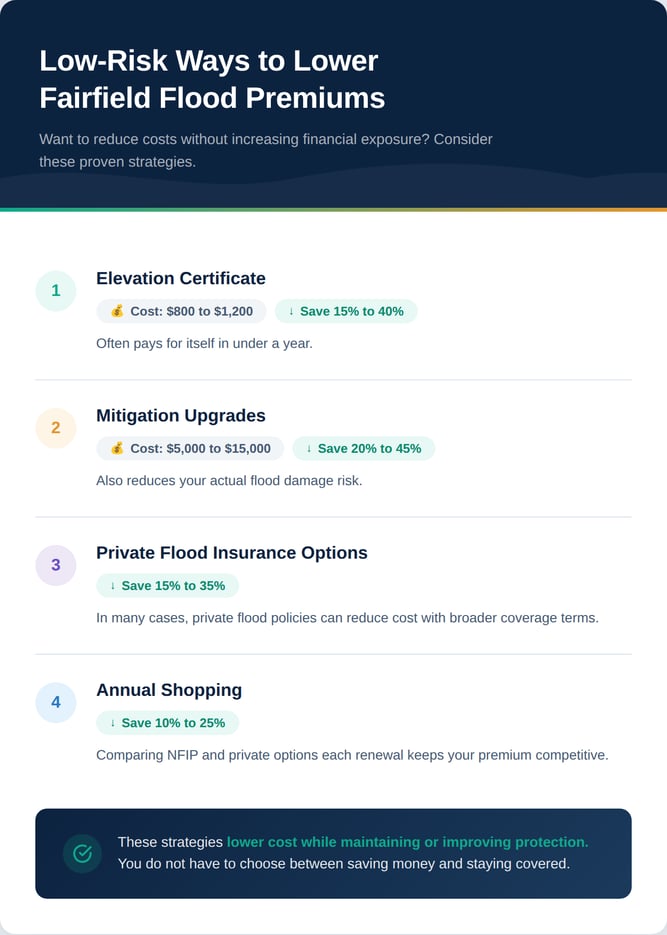
Smarter Ways to Lower Fairfield Flood Premiums
Frequently Asked Questions
What deductible is best for Fairfield homeowners?
For most homeowners, $1,000. It balances manageable claim time costs with only a small premium difference.
How much do premiums drop with a $10,000 deductible?
Typically $70 to $140 per year in coastal AE and VE zones, about 2 to 5 percent.
What is the break even point?
Approximately 60 to 65 claim free years. That is unlikely given Fairfield’s coastal storm cycle.
What lowers premiums more effectively than raising the deductible?
Elevation Certificates, mitigation upgrades, private flood options, and annual comparison shopping can reduce premiums by 10 to 45 percent.
What This Means for Fairfield Homeowners
For most Fairfield properties, sticking with a $1,000 flood deductible is the financially sound choice.
Higher deductibles typically reduce premiums by only 2 to 5 percent, yet increase out of pocket exposure by $9,000 or more per claim. With coastal storm events occurring far more frequently than once every 60 years, most households will face a claim long before higher deductibles pay off.
If your goal is to control premium while protecting your balance sheet, focus on elevation data, mitigation strategies, private flood comparisons, and annual policy reviews.
Small savings are not worth large surprises. Click below to see if a higher deductible is worth it for your situation.