
Sussex County, Virginia Flood Map Changes: The Good, the Bad, and the Ugly
November 28th, 2026
5 min read
By Chris Greene
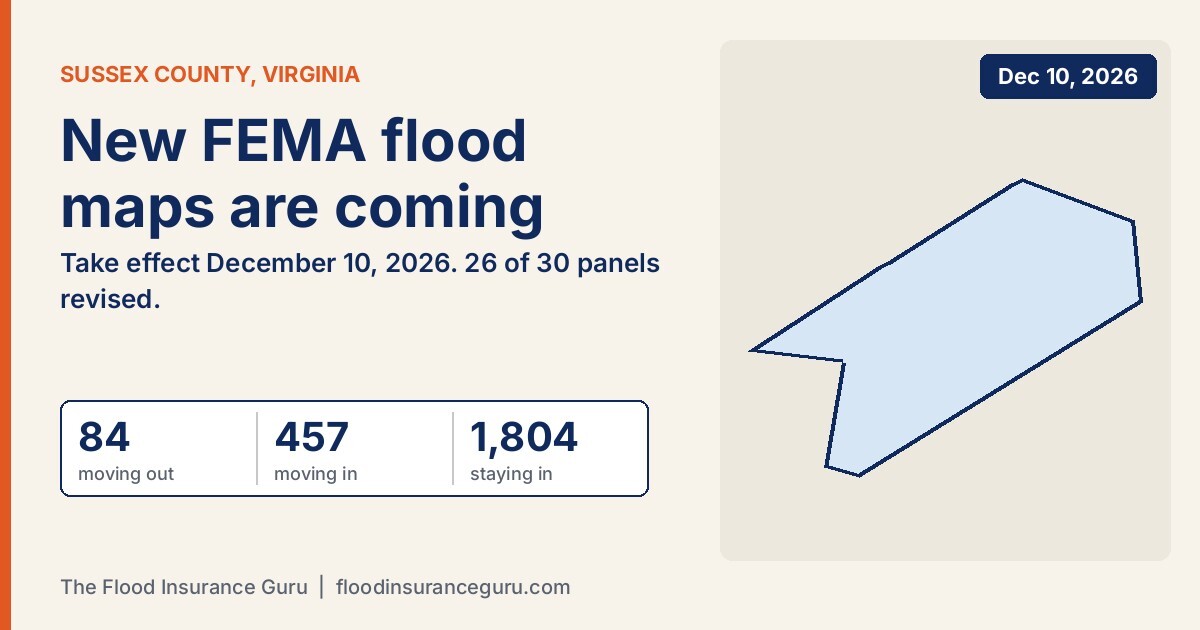
Sussex County, Virginia is getting new FEMA flood maps on December 10, 2026. The update replaces the county's 2009 maps and covers unincorporated Sussex County along with the towns of Stony Creek, Wakefield, and Waverly. With 26 of the county's 30 map panels changing, this is close to a full redraw, and almost every property in the county falls inside the study area.
The quick version: New FEMA flood maps for Sussex County take effect on December 10, 2026. About 84 properties are expected to move out of the high-risk flood zone, 457 will move in, and 1,804 will stay in. Some owners will get relief, more will pick up a new requirement, and the largest group will keep the requirement they already have. All three groups have something to do before the effective date.
At a glance
| Item | Figure |
|---|---|
| New maps take effect | December 10, 2026 |
| Current map date | July 7, 2009 |
| Map panels revised | 26 of 30 |
| Properties in the study area | 10,763 |
| Properties in the revised areas | 10,763 |
| Moving out of the high-risk zone | 84 |
| Moving into the high-risk zone | 457 |
| Staying in the high-risk zone | 1,804 |
| Share of all properties changing zone | 5.0% |
| NFIP policies in force | 46 |
Figures are approximate estimates based on FEMA's Letter of Final Determination and parcel-level impact analysis, not official flood zone determinations for any single property.
Flood risk in Sussex County
Sussex County sits on Virginia's flat coastal plain, drained by the Nottoway River, the Blackwater River, and Stony Creek, a 21 mile tributary that joins the Nottoway at the town of Stony Creek. These are slow, swampy river systems. Flooding here tends to build over days after heavy tropical rains rather than arriving as a sudden wall of water, which can lull people into thinking they have more time than they do. Low ground along the rivers and swamps holds water for a long time once it arrives.
The restudy has been moving for a while. Preliminary maps were released January 15, 2025, and the 90-day appeal period began October 1, 2025. The communities included are unincorporated Sussex County and the towns of Stony Creek, Wakefield, and Waverly. Floodplain questions go to the Sussex County Planning and Zoning Department.
The Good: 84 properties moving out of the high-risk zone
For 84 property owners, the new map removes the Special Flood Hazard Area (SFHA) designation, the high-risk zones that start with A or V. That can mean the end of the lender's flood insurance requirement, but only if the lender agrees. Lenders may drop the requirement; they are not obligated to. Ask for written confirmation once the new map is effective.
If you have an NFIP policy and the requirement is lifted, you can cancel and get a pro rata refund of the current policy term only, without refunds of fees, surcharges, or prior years. Do not expect a lower premium just because the zone changed; Risk Rating 2.0 does not rate on zone. Our advice is to keep the coverage. FEMA reports that one-third of NFIP claims from 2013 to 2023 came from outside high-risk flood areas. The upside of moving out is that coverage becomes your choice, so you can adjust limits and deductible or compare private flood options on your own terms.
The Bad: 457 properties moving into the high-risk zone
457 properties are expected to be mapped into the SFHA for the first time. If one of them is yours and you have a mortgage from a federally regulated or backed lender, expect a notice after December 10, 2026. From the date of that notice you have 45 days to show proof of flood insurance, or the lender will force-place coverage, which is typically much more expensive.
The NFIP softens the landing in two ways. The Newly Mapped discount applies if your policy is in effect within 12 months of the new map's effective date: a statutory 70% discount on the first-year premium for the first $35,000 of building coverage and the first $10,000 of contents coverage. From there, the premium rises no more than 18% per year until it reaches the full-risk rate, and a lapse of more than 30 days forfeits the discount. Also, if your building is newly mapped into a high-risk zone, the usual 30-day waiting period shrinks to 1 day when you buy within 13 months of the effective date. You can buy before December 10, 2026 as well; there is no reason to wait for the lender's letter.
The Ugly: 1,804 properties staying in the high-risk zone
The largest group in Sussex County is the 1,804 properties that are in the high-risk zone today and will still be in it on December 10, 2026. If you were hoping the restudy would take you out, it did not. The mandatory purchase requirement continues, and the new maps bring updated base flood elevations (BFEs) and boundaries that can affect permits and building rules.
Start with your paperwork. If your property has a Letter of Map Amendment (LOMA), look for it on FEMA's LOMA Revalidation Letter. LOMAs can be listed as valid, incorporated, or superseded, and a superseded LOMA has to be refiled against the new map. If you think your structure is above the new BFE, a LOMA request to FEMA costs nothing, though you will need elevation data from a licensed surveyor or engineer. And if you are planning a substantial improvement or would need to rebuild after a flood, the new BFE may change how high the building must be.
An elevation certificate is optional for NFIP rating under Risk Rating 2.0, but it can give an insurer better information about your building and often helps with private carriers. For more on what high-risk zones mean, see our Zone A guide.
What to do before December 10, 2026
- Check your property on FEMA's Flood Map Service Center or our flood zone lookup, or call the Sussex County Planning and Zoning Department at 434-246-1043. The county keeps a floodplain management page.
- Contact your lender or servicer to ask how the new map will affect your loan, and keep any answer in writing.
- Compare NFIP and private flood quotes before the effective date, not after the lender's notice.
- Locate or order an elevation certificate if you are near the Nottoway, Blackwater, or Stony Creek.
- If you hold a LOMA, check the Revalidation Letter and refile if it is superseded.
- Agents and loan officers: flag any Sussex County closing scheduled around December 10, 2026, and confirm which map the flood determination will use.
NFIP or private flood insurance in Sussex County
For most homes, the NFIP is the familiar choice, with residential limits of $250,000 for the building and $100,000 for contents. Private flood insurance can go beyond those limits and may add loss of use coverage, replacement cost options, and shorter waiting periods, depending on the carrier. Federally regulated lenders must accept private policies that meet the federal definition (a rule effective July 1, 2019). FHA lenders may accept qualifying private flood since December 21, 2022, and USDA guaranteed loan lenders must accept qualifying private flood, which matters in a rural county like this one. We place both NFIP and private flood in Virginia. One more tip: almost always add contents coverage, and for a primary residence set it at about 50 to 60% of the building amount.
Frequently asked questions
When do the new Sussex County flood maps take effect?
December 10, 2026. The current maps stay in effect until then.
Which parts of Sussex County are included?
Unincorporated Sussex County and the towns of Stony Creek, Wakefield, and Waverly. With 26 of 30 panels changing, nearly the whole county is covered.
My home is being mapped into a flood zone. What will flood insurance cost?
There is no single number. Under Risk Rating 2.0, price depends on your building's elevation, foundation, distance to water, and other details. The Newly Mapped discount takes 70% off the first-year premium on the first $35,000 of building and $10,000 of contents coverage, and a private quote is worth comparing.
My home is moving out of the flood zone. Can I cancel?
Only if your lender agrees to drop the requirement. Even then, we recommend keeping coverage, since one-third of NFIP claims from 2013 to 2023 came from outside high-risk areas.
December 10, 2026 will arrive quickly. Request a free flood insurance quote, call us at 205-451-4294, or have us review your current flood policy so you know exactly where you stand before the new Sussex County maps take effect.
Topics: