

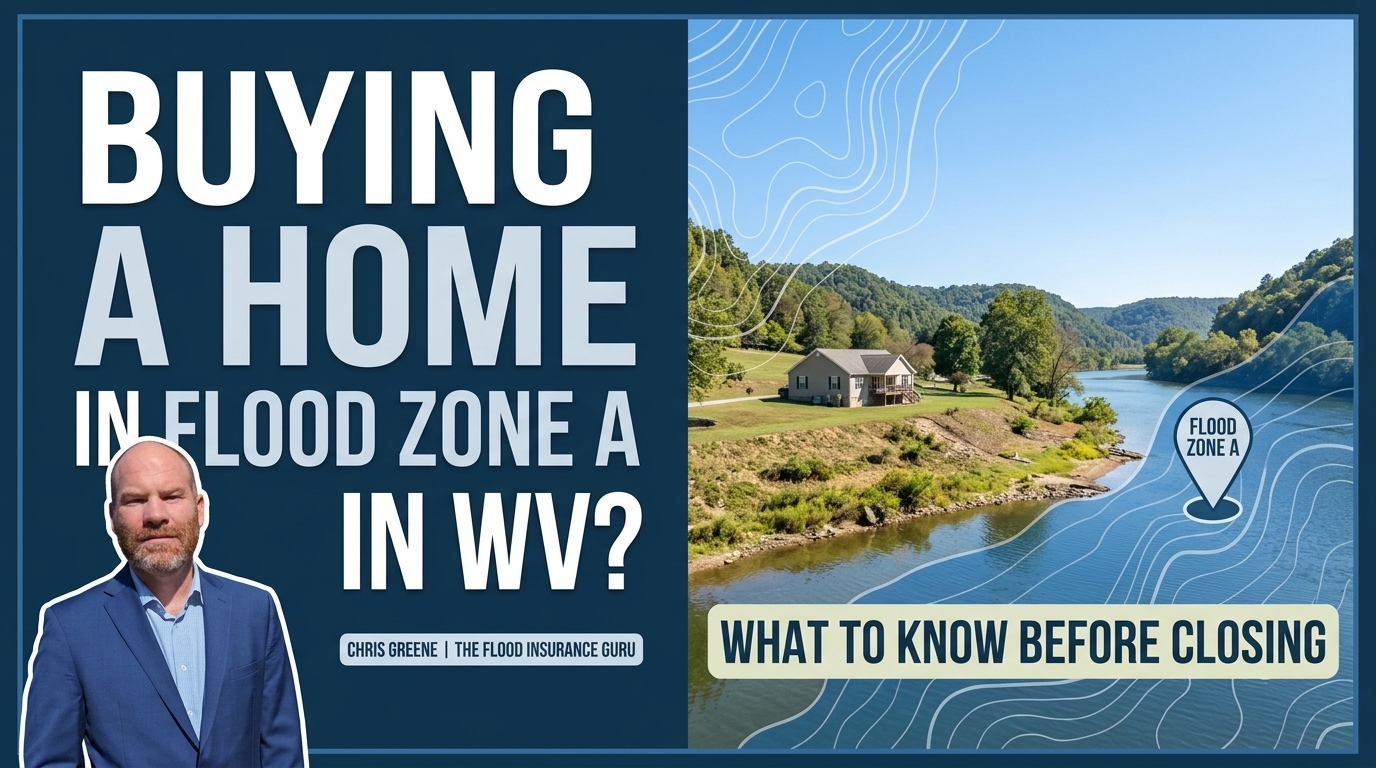
Buying a Home in Flood Zone A in West Virginia? What to Know Before Closing
Executive Summary
If you are buying a home in unnumbered Flood Zone A in West Virginia, get your flood insurance numbers before your inspection or financing contingencies expire, not a few days before closing.
Flood Zone A is a high-risk flood area, but unlike Zone AE, FEMA generally does not show a Base Flood Elevation, or BFE, on the map. That can make the property harder to evaluate.
Based on more than 200 West Virginia flood insurance quotes our team has reviewed, we have not seen Elevation Certificates materially reduce premiums on the unnumbered Zone A properties represented in our data.
That does not mean an Elevation Certificate is useless. FEMA can use elevation information in rating. But based on what we have actually seen in West Virginia, you should not pay for one simply because someone told you it will automatically lower the premium.
Before you buy, you should:
- Get an NFIP quote and compare available private flood options.
- Ask the county whether local flood-elevation information already exists.
- Find out whether an Elevation Certificate is already available.
- Compare coverage and deductibles, not just the annual premium.
- Look at where an existing NFIP policy sits relative to its full-risk premium.
- Stress-test what the policy could cost after several renewals.
- Confirm that any private flood policy you plan to use satisfies your lender's requirements.
The question is not simply what flood insurance costs today. It is what this property could cost you to insure over the next several years.
Why should you get a flood insurance quote before the final two weeks of closing?
We regularly see buyers begin seriously investigating flood insurance after the inspection is complete, the appraisal is done, and closing is getting close.
By then, you have already spent money. More importantly, you may have already decided emotionally that this is your house.
That is a bad time to discover that the flood premium changes whether the home actually fits your budget.
The problem is not always that coverage cannot begin in time. The NFIP normally has a waiting period, but exceptions apply in certain loan-related situations. The bigger problem is lost decision-making leverage.
Several weeks before closing, you may still have time to investigate the property, compare policies, question the seller, and decide whether the numbers make sense. A few days before closing, you may be asking whether you are really willing to walk away after paying for inspections, appraisal, title work, and other transaction costs.
That is why flood insurance belongs near the beginning of your due diligence—not at the end.
Video: Flood insurance waiting periods
External reference: FEMA flood insurance information.
Is flood insurance required when buying a home in Flood Zone A?
If the building securing your loan is located in a Special Flood Hazard Area and the loan is subject to federal mandatory-purchase rules, flood insurance is generally required.
Zone A is part of FEMA's Special Flood Hazard Area and is associated with the 1%-annual-chance flood. In unnumbered Zone A, detailed hydraulic analysis generally has not been completed, so BFEs are not shown.
Your lender will make its own flood determination for the loan. If the lender's determination conflicts with your survey, Elevation Certificate, or what you see on a FEMA map, start by asking for the lender's actual flood determination.
Read what to do when your lender says Zone AE but your survey says Zone X.
External reference: FEMA flood-zone glossary.
What is the difference between Flood Zone A and Flood Zone AE?
People often use Zone A and Zone AE as if they mean the same thing. They do not.
Both are high-risk Special Flood Hazard Areas associated with the 1%-annual-chance flood, but the available flood-elevation information is different.
| Question | Flood Zone A | Flood Zone AE |
|---|---|---|
| High-risk Special Flood Hazard Area? | Yes | Yes |
| Subject to the 1%-annual-chance flood? | Yes | Yes |
| BFE generally shown? | No | Yes |
| Based on detailed hydraulic study? | Generally no | Yes |
| Federal flood-insurance requirements may apply with a qualifying loan? | Yes | Yes |
That difference changes what elevation information is readily available when you are evaluating the property. It does not mean current NFIP pricing is based only on the zone designation.
Video: Flood Zone A vs. Flood Zone AE
Do Elevation Certificates lower Flood Zone A premiums in West Virginia?
That is an observation from our quote experience, not a claim that an Elevation Certificate can never affect an NFIP premium.
FEMA can use Elevation Certificate information when evaluating first-floor-height data. The practical question is whether that verified information actually improves the rating result enough to matter.
In our West Virginia Zone A experience, we have not seen that material savings appear.
That means the right question is not, "Should I get an Elevation Certificate?" It is:
"What specific problem will a new Elevation Certificate solve on this property?"
- Does the seller already have one?
- Does the builder, surveyor, county, or floodplain manager already have elevation information?
- Does the community have a locally determined elevation or other usable flood data?
- What specific rating input would change if a new certificate were provided?
- Is your agent expecting that change to materially affect the premium?
Do not buy a survey hoping it creates a discount. Make sure it solves a known problem first.
An Elevation Certificate can still be useful for floodplain management, permitting, building information, or certain FEMA map-change requests.
For comparison, read when an Elevation Certificate may lower flood insurance in Zone AE.
What should you check if the seller never carried flood insurance?
A pattern we see in rural West Virginia is a seller who built the home or bought it with cash and never had a lender requiring flood insurance.
That does prove no flood policy ever existed. It may simply mean there is no current lender-required policy history available to review.
Ask the seller for:
- Current or previous flood insurance declarations pages.
- Any Elevation Certificate.
- Flood-loss or water-intrusion disclosures.
- Flood-related repair permits.
- Documentation of substantial improvements.
- Surveys.
- FEMA correspondence.
- Local floodplain-management documentation.
No previous flood policy does not mean no flood risk. It may only mean no lender required the owner to insure it.
How can an NFIP renewal show where the premium may be headed?
One of the most useful documents you can review is an existing NFIP declarations page.
We are using an anonymized real renewal here to show what to look for. The customer's name, address, policy number, lender information, and agent information are not used.
The number we want you to notice is not only the $1,962 total annual payment.
Full-Risk Premium: $2,824
Annual Increase Cap Discount: $1,222
That means the current discounted premium is still below the full-risk premium calculated for the current policy term.
The policy carries $88,000 in building coverage, no contents coverage, and a $5,000 building deductible, so the $1,962 annual payment should not be treated as an average West Virginia flood-insurance cost. It is being used to explain the mechanics of the declarations page.
If you only look at the total amount due today, you may miss that the policy is still receiving a substantial annual-increase discount.
How much could an NFIP premium increase over several renewals?
Many NFIP policies that are below full-risk pricing can increase at renewal subject to statutory caps.
For most policies, FEMA identifies an annual premium increase cap of 18%, though different statutory rules can apply to certain categories. FEMA also notes that fees and surcharges are not necessarily subject to that same cap.
Using the real renewal above, the discounted premium is $1,602.
If that premium increased by 18% at each renewal and the current $2,824 full-risk premium stayed unchanged, the illustration would look like this:
| Policy point | Illustrative premium before fees and surcharges |
|---|---|
| Current term | $1,602 |
| After one renewal | $1,890 |
| After two renewals | $2,231 |
| After three renewals | $2,632 |
| After four renewals | $2,824 |
This is a stress test, not a forecast.
The full-risk premium itself can change. So can property information, coverage, deductibles, fees, surcharges, claims information, and program rules.
The better question is: How far is this policy from its current full-risk premium?
What property factors affect a West Virginia flood insurance premium?
Under Risk Rating 2.0, NFIP pricing is more property-specific than the older zone-based approach.
- Flood frequency.
- Flood type.
- Proximity to flood sources.
- First-floor height.
- Foundation characteristics.
- Building characteristics.
- Replacement cost.
- Coverage limits.
- Deductibles.
This means two homes in the same flood zone can receive very different premiums.
For West Virginia buyers, that matters because a creek that looks insignificant during dry weather may still matter to the insurance model.
The creek behind the home is not automatically a footnote. It can be part of how the property's flood exposure is evaluated.
What should you compare in an NFIP and private flood insurance quote?
Do not compare flood insurance by looking at two annual premiums and choosing the cheaper one.
A lower premium does not automatically mean a better policy.
| Item | What you should check |
|---|---|
| Building coverage | How much of the structure is insured? |
| Contents coverage | Is it included, optional, or excluded? |
| Building deductible | How much do you pay before building coverage responds? |
| Contents deductible | Is it separate? |
| Loss settlement | Replacement cost or actual cash value? |
| Basement limitations | What is restricted below grade? |
| Additional living expenses | Included or excluded? |
| Increased Cost of Compliance | What does the policy provide? |
| Flood definition | What events qualify as a covered flood? |
| Cancellation | When can coverage terminate? |
| Nonrenewal | What can happen at renewal? |
| Lender acceptance | Has the lender approved the private policy? |
| Current premium | What is due now? |
| Renewal exposure | What information can you use to stress-test future costs? |
For regulated lenders, qualifying private flood insurance that meets the federal definition must be accepted when it satisfies the required coverage amount. Lenders may also choose to accept certain other private policies under discretionary acceptance rules.
Get the lender's approval of the specific private policy before relying on it for closing.
Read How to Shop Flood Insurance: NFIP vs. Private
Read the 7-Step Flood Insurance Comparison Guide
Video: Private flood insurance questions answered
External reference: FDIC Flood Disaster Protection Act guidance on private flood insurance acceptance.
When can buying a Flood Zone A property still make sense?
Being in Flood Zone A is not automatically a reason to walk away.
The decision comes down to whether you understand the exposure and can absorb the cost.
- The current premium fits comfortably within your budget.
- The renewal stress test remains manageable.
- You understand the policy's full-risk premium or private-market renewal uncertainty.
- The deductible is affordable.
- The property has favorable physical characteristics.
- The purchase price reflects the flood exposure.
- You understand previous flood history.
- You can absorb a future insurance increase.
- You have considered the impact on resale.
Flood insurance is not only a monthly-payment problem. It can become a resale problem.
The next buyer will likely ask many of the same questions you are asking now.
Should you buy flood insurance if the property is in Zone X?
Zone X does not mean no flood risk.
Zone X is outside the Special Flood Hazard Area, but it can represent either moderate or lower mapped flood risk depending on the specific designation.
Even if flood insurance is not required, get a quote and evaluate it.
- The annual cost.
- Proximity to water.
- Drainage.
- The deductible.
- Available coverage.
- Your ability to absorb an uninsured loss.
If your lender is requiring coverage even though the property appears to be in Zone X, read why a lender may still require flood insurance in Zone X.
Frequently Asked Questions About Buying a Home in Flood Zone A in West Virginia
Is Flood Zone A considered a high-risk flood zone?
Yes. FEMA classifies Zone A as a Special Flood Hazard Area subject to the 1% annual-chance flood. In unnumbered Zone A, detailed hydraulic analysis generally has not been completed, so Base Flood Elevations are not shown on the map. Mandatory flood insurance purchase requirements may apply when the building secures a qualifying regulated loan.
What is the difference between Flood Zone A and Flood Zone AE?
Both Zone A and Zone AE are high-risk Special Flood Hazard Areas associated with the 1% annual-chance flood. The key difference is that Zone A generally does not have a mapped Base Flood Elevation, while Zone AE does because Zone AE has been studied using more detailed methods.
Will an Elevation Certificate lower my Flood Zone A premium in West Virginia?
It can provide useful elevation and first-floor-height information for NFIP rating, but it does not guarantee a lower premium. Based on more than 200 West Virginia flood insurance quotes our team has reviewed, we have not seen Elevation Certificates materially lower premiums on the unnumbered Zone A properties represented in our data. Before paying for one, check whether an existing certificate or local elevation information is already available and ask what specific rating input a new certificate is expected to change.
Can an NFIP flood insurance premium increase every year?
Yes. An NFIP premium may increase at renewal if the policy is still below its calculated full-risk premium. Most policies are subject to an annual premium increase cap of 18%, although different statutory rules can apply to certain properties or policy categories. Fees, surcharges, changes in coverage, deductibles, property information, and other policy changes may also affect the total amount due.
Can I use private flood insurance instead of the NFIP?
Potentially. A regulated lender must accept private flood insurance that meets the federal definition of private flood insurance and the required coverage amount. Lenders may also choose to accept some policies under discretionary-acceptance rules. Get your lender's approval of the specific policy before relying on it for closing.
Should I buy flood insurance if the property is in Zone X?
You should at least get a quote and evaluate the risk rather than assuming Zone X means no flood risk. Zone X is outside the Special Flood Hazard Area, but it can represent either moderate or lower mapped flood risk depending on the specific designation. Consider the premium, proximity to water, drainage conditions, deductible, available coverage, and your ability to absorb an uninsured flood loss.
What should you do before buying the home?
- Get the lender's flood determination.
- Get an NFIP quote.
- Shop available private flood options.
- Confirm lender acceptance before relying on private coverage.
- Ask for any existing NFIP declarations page.
- Check for an Elevation Certificate or local elevation data.
- Compare limits, deductibles, exclusions, and additional coverage—not just price.
- Review the Full-Risk Premium and Annual Increase Cap Discount on an existing NFIP policy.
- Stress-test what future renewals could do to your budget.
- Decide whether the home still works financially if the insurance cost rises.
You started this process trying to determine whether the house itself is affordable. Now you know that the flood insurance cost has to be part of that answer.
At The Flood Insurance Guru, flood insurance is our focus. We help property owners compare NFIP and private options and understand the flood-risk questions that can affect a purchase.
Get the flood numbers before they become a closing-day surprise
Request a property-specific flood insurance review before your contingencies expire.

