

By Chris Greene | Flood Insurance Guru
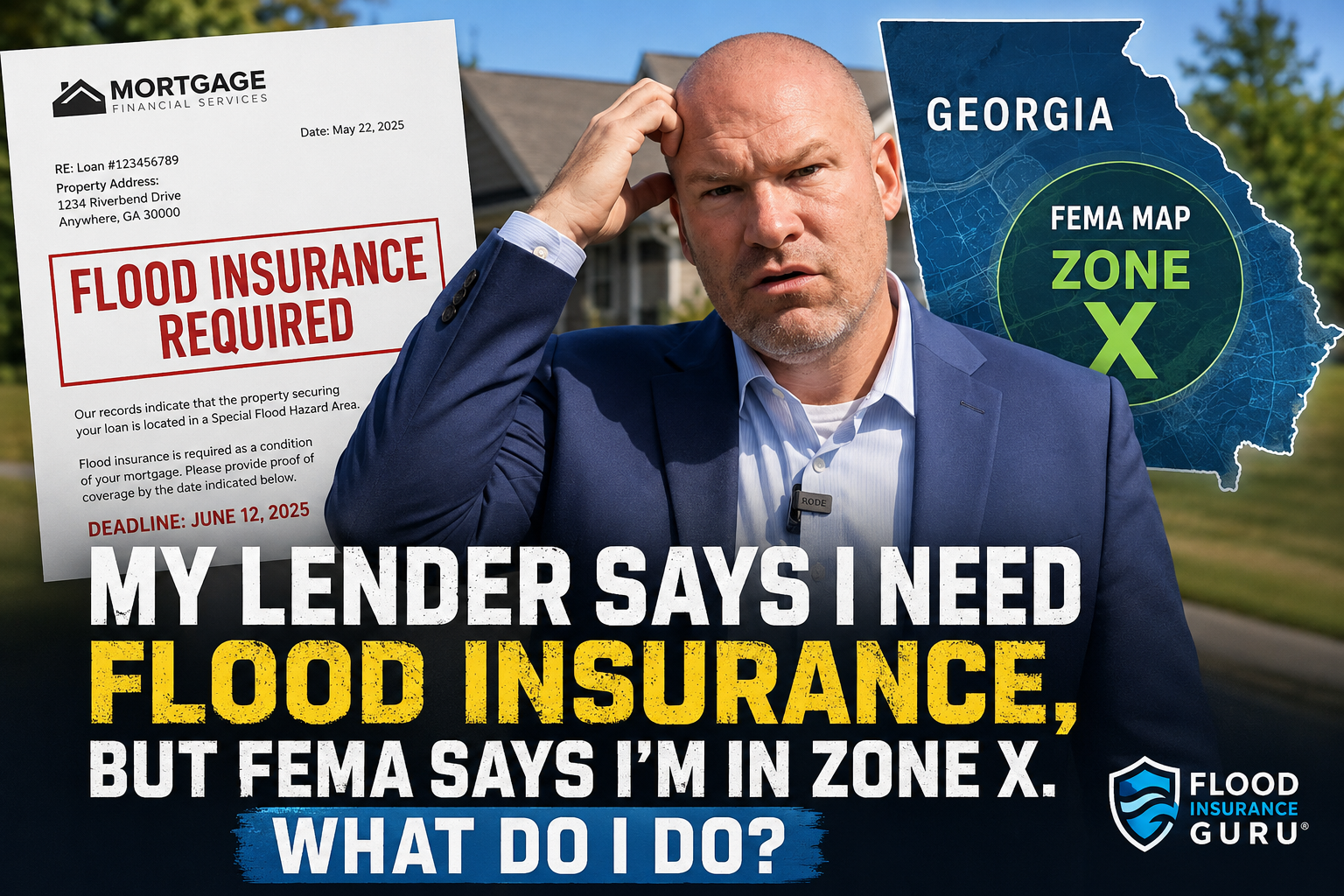
My Lender Says I Need Flood Insurance, but FEMA Says I’m in Zone X. What Do I Do?
Quick answer
If FEMA appears to show Zone X but your lender says flood insurance is required, do not assume either side is automatically wrong. Get the lender’s actual flood determination first. Then verify where the building—not just the parcel—sits on the effective FEMA map, and determine whether the lender is applying its own requirement beyond the federal minimum. From there, compare the cost of coverage with the cost and likelihood of successfully disputing the determination.
You get a letter from your mortgage company saying flood insurance is required. So you check FEMA’s map, and it looks like your home is in Zone X. Now you are thinking: “If FEMA says Zone X, how can my lender make me buy flood insurance?”
That is the right question—but it is not the only question.
There are two separate issues to solve: Is the lender’s flood-zone determination correct? And even if the building is outside a Special Flood Hazard Area, does the lender still require coverage as a condition of the loan?
Federal regulators make that distinction clear. The federal mandatory-purchase rule generally applies when a building securing a regulated loan is in a Special Flood Hazard Area. But a lender may, subject to applicable law, require flood insurance outside an SFHA as part of its own lending policy. Review the Federal Reserve’s Interagency Questions and Answers Regarding Flood Insurance .
First: get the lender’s actual flood determination
Do not start the conversation with, “FEMA’s website says X, so the bank is wrong.”
Ask the lender for the flood-zone determination it is relying on. Regulated lenders use the Standard Flood Hazard Determination Form to document whether the building securing the loan is in a Special Flood Hazard Area. Federal Reserve Regulation H requires use of the form when determining whether a building or mobile home offered as loan collateral is located in an SFHA. Read Federal Reserve Regulation H .
That document gives you something concrete to compare against the current FEMA map, your survey, and the actual location of the structure.
Why can FEMA show Zone X while the lender says flood insurance is required?
1. You may be looking at the parcel instead of the building
Flood-zone boundaries do not follow property lines neatly. A parcel can contain both Zone X and Zone AE. What matters for the federal mandatory-purchase rule is the location of the building securing the loan—not whether some other part of the lot touches a high-risk zone.
The FDIC’s examination guidance states that a building located outside an SFHA is not subject to the mandatory flood-insurance purchase requirement merely because another portion of the lot extends into an SFHA. Review the FDIC Flood Disaster Protection Act guidance .
2. The map or determination dates may not match
Flood maps change. The lender may be using a newer determination than the document you are looking at—or an old survey may reference a map panel that is no longer effective. Compare the effective map date, panel, structure location, and determination date before deciding there is an error.
3. The lender may have its own requirement
This is the uncomfortable answer most homeowners want someone to say plainly: even when a building is outside an SFHA, a lender may still require flood insurance as a condition of the loan, depending on its policies and applicable law. That is different from saying the federal government requires it.
4. There may be a real discrepancy that needs to be resolved
Federal interagency guidance specifically addresses borrower disputes. When the lender says the building is in an SFHA and the borrower disputes it, the parties are encouraged to resolve the discrepancy before seeking a final FEMA determination. Review the federal flood-zone discrepancy guidance .
What does Zone X actually mean?
Zone X is outside FEMA’s Special Flood Hazard Area. It can represent minimal mapped flood hazard, such as unshaded Zone X, or moderate mapped hazard, such as the 0.2%-annual-chance area shown as shaded Zone X.
FEMA’s NFIP Flood Insurance Manual explains that the federal mandatory flood-insurance purchase requirement does not apply in these moderate- or minimal-hazard areas. Review FEMA’s NFIP Flood Insurance Manual .
But “outside the federal mandatory-purchase area” is not the same thing as “cannot flood.” Zone X is a mapping designation, not a guarantee that water will never reach the property.
Want to verify what Flood Insurance Guru is seeing for your address? Verify Your Flood Zone .
Should I fight the lender or just buy the flood insurance?
This is the decision most homeowners actually need help making. And the answer is not always “fight the bank.”
Start with the numbers. In Flood Insurance Guru’s 2026 Georgia flood insurance cost report , 17 Zone X quotes had a median premium of $345 per year, with quotes ranging from $160 to $725 per year.
That is agency data—not a statewide average or a promise of what your home will cost—but it gives you a real comparison point.
Now compare that potential premium with:
- the cost of obtaining new survey or elevation information, if needed;
- the time involved in challenging the determination;
- the likelihood that the building actually qualifies for a map correction;
- the lender deadline you are facing;
- how long you expect to own the property; and
- what the issue could mean when you refinance or sell later.
Sometimes inexpensive coverage is the simplest solution. Sometimes the determination is clearly worth disputing. And sometimes the smartest move is to do both: satisfy the lender now while working on the long-term correction.
Do not automatically order an Elevation Certificate
A flood-zone dispute does not automatically mean you should spend money on an Elevation Certificate . First determine what you are trying to prove and what information already exists.
Depending on the property, we may look at:
- the current FEMA map and panel date;
- the building footprint;
- an existing survey;
- an existing Elevation Certificate ;
- Base Flood Elevation, when applicable;
- Lowest Adjacent Grade;
- whether fill was used; and
- whether a prior FEMA map-change determination already exists.
The goal is not to buy more paperwork. The goal is to figure out whether the lender requirement can actually be changed.
Could a LOMA solve the problem?
Potentially. If the building was mapped into the SFHA but elevation and natural-ground information support removing it, a Letter of Map Amendment may be appropriate. A successful FEMA map-change determination can affect the federal mandatory-purchase requirement, although a lender may still impose its own coverage requirement.
Flood Insurance Guru’s Flood Zone Change / LOMA service explains the review, document, and submission process.
What I would ask you to send first
If you call us and say, “My lender requires flood insurance, but FEMA shows Zone X,” start with these items:
- The lender letter or notice.
- The lender’s flood determination, if you have it.
- The property address.
- Any existing survey or Elevation Certificate.
- Basic building information such as year built and square footage.
That is enough to start separating the immediate insurance issue from the mapping issue.
The three-step plan
Step 1: Get the lender’s determination
Do not fight a document you have not seen. Find out exactly what the lender is relying on and what deadline applies.
Step 2: Verify the building and current map
Compare the lender determination with the effective FEMA map, building footprint, survey, and available elevation information.
Step 3: Solve the immediate and long-term problems separately
If coverage is needed now, compare NFIP and private options. If the mapping evidence supports a challenge, pursue the appropriate correction without letting the lender deadline turn into a larger problem.
Frequently asked questions
Is flood insurance federally required in Zone X?
Generally, the federal mandatory-purchase requirement applies to buildings in Special Flood Hazard Areas, not Zone X. A lender may still require coverage outside an SFHA under its own policy, subject to applicable law.
Can my bank require flood insurance even if FEMA says Zone X?
Potentially, yes. First confirm that the lender actually agrees the building is in Zone X. If it does, the requirement may be a lender-specific condition rather than the federal mandatory-purchase rule.
Could my lender’s flood-zone determination be wrong?
Yes, discrepancies can occur. Federal interagency guidance specifically addresses borrower disputes. Get the lender determination and compare it with the effective FEMA map and the actual building location before deciding what to challenge.
What if only my yard is in Zone AE but the house is in Zone X?
For the federal mandatory-purchase rule, the location of the building matters. FDIC guidance states that a building outside the SFHA is not subject to the mandatory purchase requirement merely because another part of the lot extends into an SFHA.
Should I order an Elevation Certificate?
Not automatically. First determine whether an Elevation Certificate is actually needed to resolve the discrepancy or support a FEMA map-change request.
Should I still consider flood insurance in Zone X?
Yes. Zone X means lower mapped risk, not zero risk. The decision should be based on the property’s actual exposure, available coverage, premium, and your financial tolerance for a flood loss.
Your bank says flood insurance is required. FEMA appears to say Zone X. Do not guess.
Start by finding out why the information does not match. Then decide whether the right move is to secure coverage, challenge the determination, or do both.

