

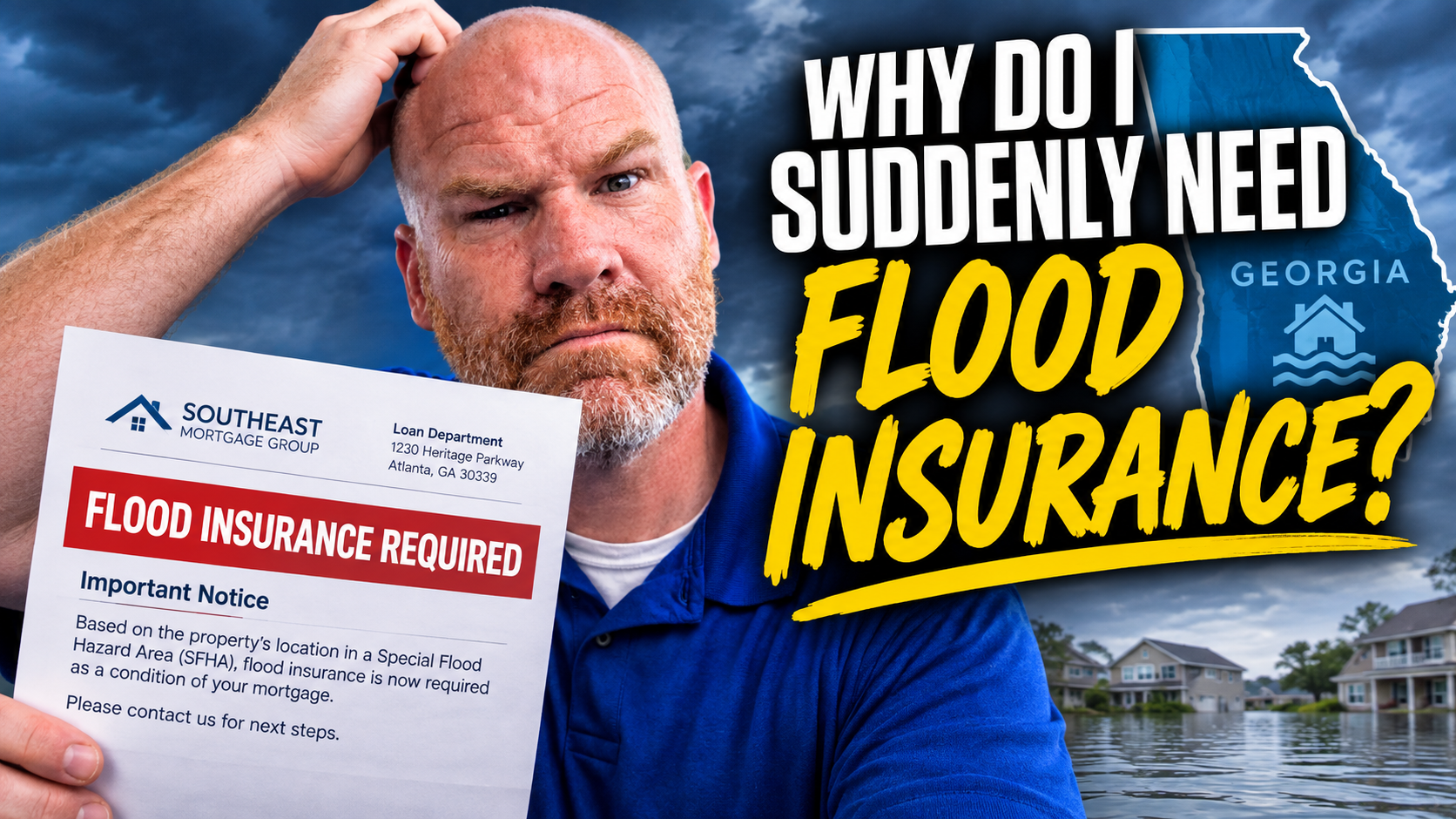
Why Does My Mortgage Company Suddenly Require Flood Insurance in Georgia?
By Chris Greene
Flood Insurance Guru
Last updated: August 19, 2026
You may have owned your Georgia home for years without being required to carry flood insurance. Then a letter arrives from your mortgage company saying flood insurance is now required.
Why now? Did your flood zone change? Did your lender make a mistake? And what should you do if you disagree with the determination?
At Flood Insurance Guru, we've worked with Georgia property owners dealing with lender flood-zone requirements, map changes, mortgage and servicer changes, and conflicting flood-zone information. One thing we've learned is that a new flood insurance requirement doesn't necessarily mean your property suddenly became more likely to flood.
It could be connected to the effective flood map, a new lender or servicer, a refinance or HELOC, or information being used in the lender's flood determination.
In this article, you'll learn why a mortgage company can suddenly require flood insurance, what information you should request from your lender, and what to do if you believe the flood-zone determination deserves another look.
Executive Summary
If your Georgia mortgage company suddenly requires flood insurance after years without it, don't assume your flood risk suddenly changed, or that the lender made a mistake. Therequirement may be connected to a FEMA map change, a new lender or servicer, a refinance or HELOC, or a new flood-zone determination.
Your first step should be to ask your lender for the flood-zone determination they're using. Then compare that information with the current flood map and your property information.
If coverage is currently required, address that requirement while separately investigating whether the flood-zone determination should be reviewed.
Why Would My Lender Suddenly Require Flood Insurance?
There isn't one explanation for every unexpected flood insurance requirement. Before you dispute the requirement or start paying for surveys and Elevation Certificates, you need to understand what triggered it.
Here are five possibilities.
1. Your FEMA Flood Map Changed
A property that previously wasn't shown in a Special Flood Hazard Area can be affected when a new map becomes effective.
We've seen this happen with Georgia homeowners who receive a lender notice following a map update.
A past flood-zone determination doesn't necessarily tell you what the effective map shows today.
See the latest Georgia flood map updates to learn more about map changes affecting Georgia communities.
2. Your Mortgage Was Sold or Your Servicer Changed
A new lender or servicer can conduct its own compliance review and identify a flood-insurance requirement that wasn't previously being enforced.
Flood Insurance Guru has seen this situation with transferred mortgages. Rather than assuming the new lender is wrong because the previous lender didn't require insurance, ask for the flood-zone determination behind the new requirement.
If this happened immediately after your mortgage changed hands, read My Mortgage Was Sold and Now I'm Forced to Buy Flood Insurance.
3. You Opened a HELOC or Refinanced
A new financial transaction can also trigger a new flood-hazard determination.
For example, you might wonder:
“My regular mortgage never required flood insurance. Why does my HELOC lender require it?”
The lender's Standard Flood Hazard Determination can identify information including the relevant flood map and panel, effective or revised map date, flood zone, and insurance requirement.
The important question isn't simply what your previous mortgage required. It's what information is being used for the current transaction.
FEMA provides the Standard Flood Hazard Determination form used to document this information.
4. A Previous Requirement May Not Have Been Identified
At Flood Insurance Guru, we've encountered situations where an existing loan did not have a flood-insurance requirement identified until a later lender, servicer, HELOC, or compliance review looked at the property.
That doesn't mean lenders routinely make mistakes, and it doesn't prove your new determination is correct or incorrect.
It means your previous lender's treatment of the property isn't enough, by itself, to determine whether today's requirement is accurate.
5. Something About the Flood-Zone Determination Changed
The issue may involve the structure's location, a flood-zone boundary near the structure, a map-panel change, property information, or multiple structures on the property.
Trying to diagnose the problem from the lender's letter alone can lead you in the wrong direction.
Get the actual flood-zone determination before deciding what needs to be fixed.
Why Do I Need Flood Insurance Now If I Never Needed It Before?
This is one of the most understandable reactions to an unexpected lender notice:
“I've owned this house for years. Why would I suddenly need flood insurance?”
Your previous experience doesn't automatically determine today's lender requirement.
The same is true if your home has never flooded.
Flood maps are used to represent modeled flood risk; they aren't simply a history of which individual homes have experienced flooding.
So remember these two distinctions:
- My house has never flooded ≠ my lender cannot require flood insurance.
- My previous lender didn't require it ≠ my new lender's determination must be wrong.
What matters now is identifying what determination your current lender is using and whether the information behind it matches your property.
What Should I Do After Receiving a Flood Insurance Requirement From My Lender?
Don't start by buying an Elevation Certificate or assuming you need to challenge FEMA.
Start with the lender.
Step 1: Get Your Lender's Flood-Zone Determination
Ask your lender or mortgage servicer for the flood-zone determination that is triggering the requirement.
Look for information such as:
- Flood zone
- FEMA map and panel
- Effective or revised map date
- Property or structure information
- Amount of flood insurance required
This document gives you something concrete to investigate instead of guessing why the requirement appeared.
It's also important to understand that a flood-zone determination and an Elevation Certificate serve different purposes. Read Zone Determination vs. Elevation Certificate: What's the Difference? if you're unsure which document you have or need.
Step 2: Compare the Determination With Your Property Information
Once you know what the lender is using, compare it with the information available for the property.
Depending on the situation, that could include:
- The current effective FEMA flood map
- Recent flood-map changes
- A property survey
- An existing Elevation Certificate
- The location of the insured structure
- Information about additional structures on the property
A discrepancy doesn't automatically mean the lender is wrong, but it can give you a reason to investigate further.
Step 3: Address the Requirement While You Investigate the Flood Zone
One of the most important lessons we've learned from working with property owners is this:
Don't allow a flood-zone dispute to turn into a lender problem.
If your lender currently requires coverage, address that requirement while separately investigating whether the flood-zone determination can legitimately be changed.
Disputing the zone and satisfying the current insurance requirement are not necessarily the same process.
| If this happened... | Check this... | Possible next step |
|---|---|---|
| FEMA map changed | Current effective map and date | Compare the previous and current maps |
| Mortgage or servicer changed | New flood-zone determination | Compare the information being used |
| HELOC or refinance | Transaction-specific determination | Review the lender documentation |
| Lender says AE but survey says X | Structure, map, and elevation information | Investigate the discrepancy |
What Happens If I Ignore My Lender's Flood-Insurance Notice?
Ignoring the notice can create a second problem.
If required flood coverage isn't maintained, lender-placed or force-placed flood insurance can become an issue.
The Office of the Comptroller of the Currency explains how force-placed flood insurance requirements work.
The better approach is to deal with the current insurance requirement while investigating whether the underlying flood-zone determination deserves review.
If lender-placed coverage has already been added to your loan, read Replace Force-Placed Flood Insurance in Georgia to understand your next steps.
What If I Think My Lender's Flood-Zone Determination Is Wrong?
Don't immediately assume you need an Elevation Certificate.
First determine whether your property is a reasonable candidate for further review.
That may involve examining:
- The lender's determination
- The current effective flood map
- Property survey information
- Existing elevation information
- Structure location
- Applicable Base Flood Elevation information
The goal is to determine whether spending additional money pursuing a flood-zone change makes sense before you start the process.
Does an Elevation Certificate Solve a Lender Flood-Zone Problem?
Not automatically.
An Elevation Certificate provides important elevation information, but getting one isn't necessarily the same thing as changing a flood-zone determination.
“I see homeowners get 90% of the way there. They get the Elevation Certificate done, but they never actually go through the Letter of Map Amendment process.” — Chris Greene
Before paying for an Elevation Certificate, understand what you're trying to prove, whether elevation information is actually necessary, and what steps would still remain afterward.
If you already have an Elevation Certificate, read I Got an Elevation Certificate in Georgia, Now What?.
Can I Get My Mandatory Flood-Insurance Requirement Removed?
Potentially, but it's important to separate a FEMA map determination from a lender's insurance requirement.
Federal flood-insurance rules establish mandatory coverage requirements for certain loans secured by buildings located in Special Flood Hazard Areas. You can review the Federal Reserve's flood-insurance requirements for loans in special flood-hazard areas for the regulatory requirements.
A qualifying FEMA map-change determination, such as a Letter of Map Amendment (LOMA), may affect the federal mandatory-purchase requirement when a structure is determined to be outside the Special Flood Hazard Area.
However, don't interpret that as:
“I got a LOMA, so nobody can ever require flood insurance on this property again.”
The Office of the Comptroller of the Currency explains that a lender may require flood insurance even when a home is not located in a Special Flood Hazard Area as a condition of the loan.
A change to the federal mandatory-purchase requirement and your lender's contractual insurance requirements are not necessarily the same thing.
If you're trying to determine whether your property could potentially be changed from Zone AE to Zone X, read Can Flood Insurance Guru Help Reclassify My Home From Flood Zone AE to Zone X?.
Should I Just Buy the Cheapest Flood Insurance Policy That Satisfies My Lender?
Price matters, but the cheapest first-year premium isn't necessarily the only factor worth considering.
You may want to compare:
- Current premium
- NFIP options
- Private flood insurance options
- Available coverage
- Claims history
- Carrier renewal stability
- Longer-term premium considerations
When Flood Insurance Guru evaluates private flood insurance options, we don't look only at the initial premium. We also consider factors such as the program or carrier's track record, claims experience, and servicing experience.
The goal is to solve today's lender requirement without unnecessarily creating tomorrow's insurance problem.
Frequently Asked Questions
Can My Mortgage Company Suddenly Require Flood Insurance?
Yes. A new flood determination can arise following circumstances such as a map change, loan transaction, servicing change, or another review of the property.
Get the determination being used before assuming why the requirement changed.
Can a New Mortgage Servicer Require Flood Insurance When My Old One Didn't?
It can happen. Flood Insurance Guru has seen transferred loans where a new servicer identified or applied a flood-insurance requirement that wasn't previously being enforced.
That doesn't automatically tell you which determination is correct.
Ask the new servicer for the flood-zone determination it's using and review the underlying information.
Does a Flood Insurance Requirement Mean My House Is Definitely in Flood Zone AE?
Not necessarily.
Flood Zone AE is one type of Special Flood Hazard Area, but you should look at the actual flood-zone determination rather than assuming the zone based solely on receiving an insurance notice.
What If My Lender Says Zone AE but My Survey Says Zone X?
Don't simply choose whichever document gives you the answer you prefer.
A survey notation and a lender's flood-hazard determination may not necessarily be answering the same question or relying on the same information.
Address the lender's current requirement while investigating why the documents conflict.
If you're trying to determine whether your property could potentially be changed from Zone AE to Zone X, read Can Flood Insurance Guru Help Reclassify My Home From Flood Zone AE to Zone X?.
Should I Get an Elevation Certificate?
Maybe.
First determine what you're trying to establish and whether elevation data is actually needed. An Elevation Certificate by itself doesn't automatically complete a flood-zone change.
What Happens If I Don't Buy the Flood Insurance My Lender Requires?
You risk the lender taking action to obtain required coverage.
If lender-placed coverage has already been added, read Replace Force-Placed Flood Insurance in Georgia to understand your options.
What Should You Do If Your Georgia Lender Suddenly Requires Flood Insurance?
Receiving an unexpected flood insurance requirement can be frustrating, especially when you've owned the property for years without one. But the fact that you didn't need flood insurance before doesn't prove that today's requirement is wrong.
You now know that the requirement could be connected to a flood-map change, a new lender or servicer, a refinance or HELOC, or a new review of your property's flood-zone information.
So don't start by guessing—or by immediately paying for an Elevation Certificate.
Start by getting the flood-zone determination your lender is using. If the determination and your property information don't appear to line up, that's when it may make sense to investigate further.
At Flood Insurance Guru, we help Georgia property owners understand flood-zone information and determine what their next step should be.
If you're trying to determine your property's current flood zone, start with Check My Flood Zone.
If you're specifically trying to understand whether a Zone AE determination could potentially be changed to Zone X, read Can Flood Insurance Guru Help Reclassify My Home From Flood Zone AE to Zone X?.

