

Last Updated: June 29, 2026
Written by: Chris Greene, Flood Insurance Guru
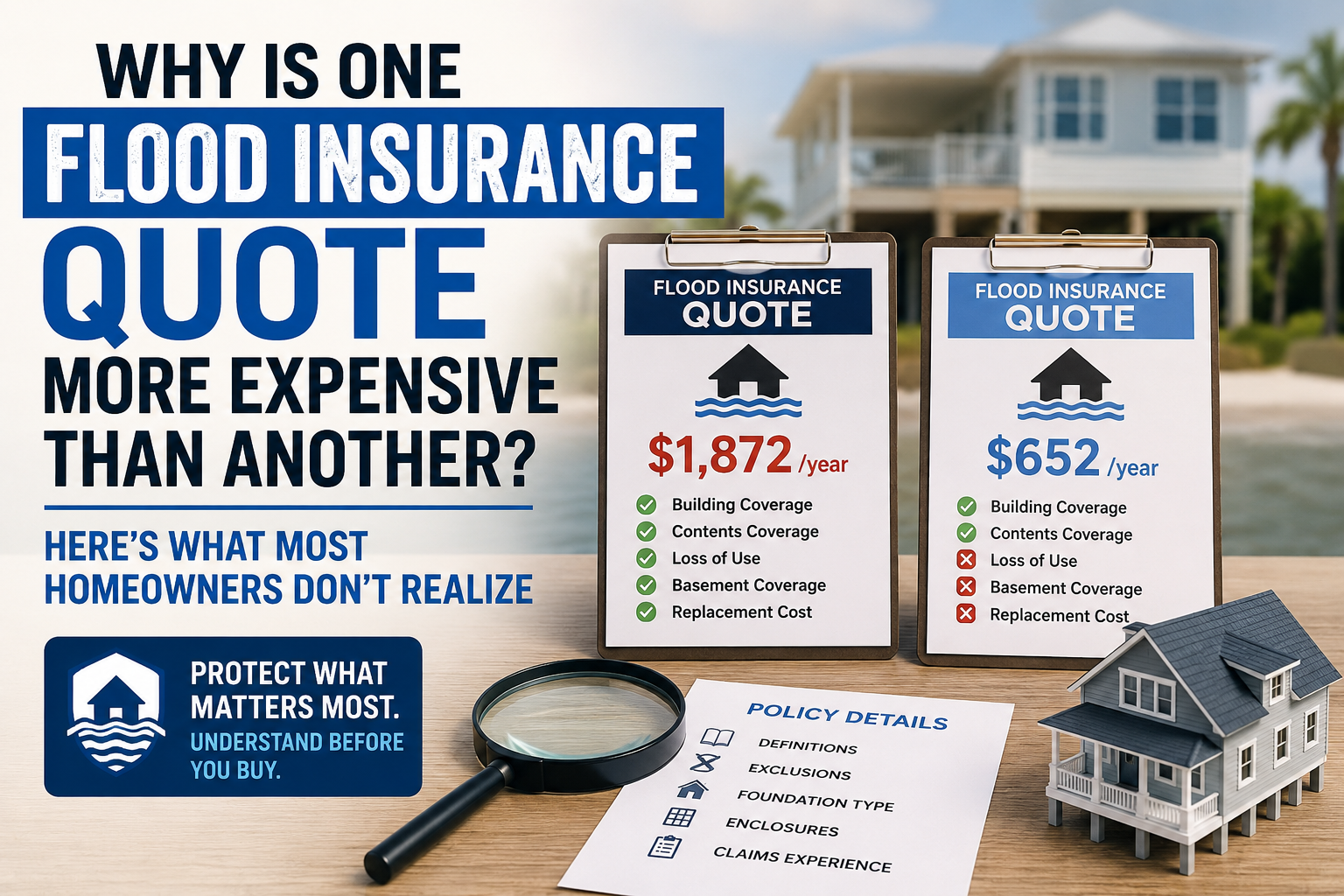
Why Is One Flood Insurance Quote More Expensive Than Another? Here’s What Most Homeowners Don’t Realize
Two flood insurance quotes can look almost identical while providing very different protection. Learn how policy definitions, exclusions, foundation types, and claims experience can affect the policy you choose.
Download the Flood Insurance Quote Comparison Checklist. Watch the Video
Why Homeowners Trust Flood Insurance Guru
- 10,000+ educational flood insurance articles
- 3,000+ flood insurance videos
- 2,000+ claims assisted during Hurricanes Debby and Helene
- Featured by media and industry outlets
- Serving homeowners across all 50 states
Executive Summary
If you received two flood insurance quotes with similar coverage limits but very different prices, do not assume the higher quote is overpriced or that the cheaper quote is automatically the better value.
Sometimes the lower-priced policy is the right choice. Sometimes the higher-priced policy includes important protections hidden in the definitions, exclusions, foundation classifications, or claims language.
At Flood Insurance Guru, we believe the best flood insurance decision is not made by comparing premiums. It is made by understanding the policy before you need to use it.
Key Takeaways
- Two flood insurance quotes can look similar but provide very different protection.
- The cheapest flood insurance policy is not always the best value.
- Policy definitions, exclusions, foundation types, basements, crawlspaces, and enclosures can affect coverage.
- NFIP and private flood insurance may treat the same property differently.
- Understanding the policy definition of a flood is one of the most important steps before buying coverage.
- Lender-required coverage may not be the same as the coverage needed to properly protect your home.
- The best time to understand your flood insurance policy is before the water rises.
In This Article You’ll Learn
- Why two flood insurance quotes can be thousands of dollars apart
- Why definitions matter more than premiums
- How foundation types can affect flood insurance claims
- Why some homeowners may choose NFIP over private flood insurance
- What we learned from helping homeowners through more than 2,000 flood claims
- The questions every homeowner should ask before buying flood insurance
I Know What It’s Like to Buy Flood Insurance Without the Right Answers
When I bought my first home in a flood zone, I thought I was asking the right questions.
Looking back, I was not.
The problem was not that I made a bad decision. The problem was that I did not know what I did not know.
No one explained how a flood insurance policy actually worked. No one walked me through the definitions. No one explained exclusions. No one talked about foundation types, basements, or how a future claim might be handled.
That lack of information cost me dearly.
That experience became one of the reasons Flood Insurance Guru exists today.
Our mission is not simply to sell flood insurance. Our mission is to answer the questions homeowners should have had answered before they ever bought a policy.
What Makes This Advice Different?
First-Hand Experience
Flood Insurance Guru was shaped by the experience of buying a home in a flood zone without getting the answers needed upfront.
Real Claims Experience
Our team helped homeowners navigate more than 2,000 flood insurance claims during Hurricanes Debby and Helene.
Deep Educational Library
We have created more than 10,000 educational articles and more than 3,000 videos about flood insurance.
Media Recognition
Media outlets and industry publications have turned to Flood Insurance Guru for flood insurance insight and education.
Why Would Anyone Choose the More Expensive Flood Insurance Quote?
We hear this question all the time.
A homeowner receives two flood insurance quotes. The coverage limits look similar. The deductibles are close. Both policies appear to satisfy the lender.
Then they ask the obvious question:
“Why would I ever choose the more expensive policy?”
It is a fair question.
The answer is that the premium is only one part of the policy. The more important differences are often found in the fine print.
If you are trying to compare policies side by side, our guide on how to compare flood insurance quotes in 7 steps walks through the broader process.
The Most Important Part of Your Flood Insurance Policy Is Not the Premium
Most homeowners compare:
- Premium
- Building coverage
- Contents coverage
- Deductible
Those numbers matter, but they do not tell the whole story.
When we compare flood insurance policies, we also review:
- Policy definitions
- Exclusions
- Foundation classifications
- Basement treatment
- Crawlspace provisions
- Enclosure limitations
- Settlement methods
- Claims language
- Underwriting guidelines
A flood quote is not just a price. It is a contract built on definitions.
Why Two Flood Insurance Quotes Are Different
- Policy definition
- Foundation type
- Coverage and exclusions
- Claims language
- Premium
The premium is the result, not the starting point.
Before Comparing Flood Insurance Quotes, Understand the Definition of a Flood
One of the first questions we ask homeowners is simple:
“Do you understand how your policy defines a flood?”
The National Flood Insurance Program defines a flood as a general and temporary condition where normally dry land is partially or completely inundated. This generally involves two or more acres of normally dry land or two or more properties, at least one of which is yours, from sources such as overflowing inland or tidal waters, rapid accumulation or runoff of surface waters, mudflow, or certain shoreline erosion conditions.
You can review FEMA’s flood definition and NFIP terminology through FEMA’s official resources, including the FEMA flood definition training page and the NFIP terminology index.
That definition matters because flood insurance does not cover every type of water damage. If a loss does not meet the policy definition of a covered flood, the flood insurance claim may not be covered.
That is why we do not start with price. We start with the policy definition.
Can Foundation Types Change Flood Insurance Coverage?
Many homeowners think of their foundation as a construction detail. Flood insurance may treat it as a coverage detail.
Over the years, we have reviewed homes with:
- Walkout basements
- Raised floor foundations
- Crawlspaces
- Slab foundations
- Elevated buildings
- Enclosures
- Finished and unfinished lower levels
To a homeowner, these may simply describe how the home was built. To an insurance carrier, they may affect underwriting, pricing, coverage, and how a future claim is handled.
That is why two policies with the same building limit can still produce very different claim outcomes. We explain basement-related considerations in more detail in 4 Types of Basements and How They Can Impact Your Flood Insurance Rates.
Sometimes We Recommend the More Expensive Flood Insurance Policy
Recently, we reviewed coverage for a homeowner with a walkout basement.
At first, the less expensive policy looked like the obvious choice. But after reviewing the home’s construction and comparing how different policies treated that foundation type, we recommended the higher-priced option.
Not because it cost more.
Because we believed it was the better fit for that property’s risk.
We have also recommended private flood insurance when it offered broader protection. We have recommended the NFIP when it better matched the property’s characteristics or claim scenario.
There is no single flood insurance policy that is always best. There is only the policy that is best for your home.
Sometimes Coverage Exists, Even When Another Broker Said It Did Not
We have had homeowners come to us after another insurance professional told them the coverage they wanted did not exist.
After reviewing the available markets, underwriting guidelines, and policy options, we found that the coverage did exist.
The issue was not that flood insurance coverage was unavailable. The issue was that the person they spoke with did not know where to look, what to ask, or how to structure the risk.
That is one of the reasons we have spent years answering flood insurance questions in depth.
What We Learned From Helping With More Than 2,000 Flood Claims During Hurricanes Debby and Helene
Experience does not just come from selling policies. It comes from helping people through claims.
During Hurricanes Debby and Helene, our team helped homeowners navigate more than 2,000 flood insurance claims.
One thing stood out:
We did not have a claim denied because the loss failed to meet the policy definition of a covered flood.
We believe that is not an accident. It comes from helping homeowners understand their policy before a flood happens.
Those claims reinforced several lessons:
- Homeowners who understood their policies had less confusion during the claim process.
- Questions about basements, crawlspaces, foundations, and enclosures came up repeatedly.
- Many claim questions could have been answered before the flood occurred.
- The policy definition of flood mattered more than the premium.
- Education before the storm is more valuable than explanations after the storm.
If you are already dealing with a claim, our article on supplemental flood insurance claims explains what homeowners should know when additional damages or claim questions arise.
For additional official claim guidance, review FloodSmart’s start a claim resource and the NFIP Claims Handbook.
NFIP vs. Private Flood Insurance: Why the Cheaper Option Is Not Always Better
Private flood insurance and NFIP flood insurance can both be valuable options, but they are not always the same.
A private flood policy may offer a lower premium, higher limits, or additional coverage options. In other situations, the NFIP may make more sense because of how the home is built, how the property is classified, or how a claim may be adjusted.
For a deeper comparison, read our guide to Private Flood Insurance vs. NFIP: Cost Over Time in 2026. You can also review FEMA’s overview of the National Flood Insurance Program and FloodSmart.gov.
| Question | NFIP Flood Insurance | Private Flood Insurance |
|---|---|---|
| Can it satisfy lender requirements? | Often, yes | Often, yes, depending on the lender |
| Can pricing vary? | Yes, based on NFIP rating rules | Yes, carrier by carrier |
| Can definitions matter? | Yes | Yes |
| Can basement treatment matter? | Yes | Yes |
| Can the cheaper option be better? | Sometimes | Sometimes |
| Can the higher-priced option be safer? | Sometimes | Sometimes |
The right answer depends on your property, your lender, your coverage needs, and the policy language.
Lender Required Coverage Is Not Always the Same as Proper Protection
Many flood insurance conversations start with the lender.
The lender may request a declarations page, proof of payment, renewal confirmation, or a certain amount of building coverage.
Those requirements matter, especially when you are buying or refinancing a home. But meeting the lender requirement does not always mean you have the right amount or type of protection.
Your lender is usually focused on protecting the loan. You should also be focused on protecting your home, your belongings, and your financial future.
Meeting the lender requirement may get you to closing. It may not get you fully protected.
Pricing is affected by more than just the flood zone. Replacement cost, elevation, foundation type, and other property characteristics can all matter. Learn more in Why Is Flood Insurance So Expensive in Flood Zone AE?
What Most Homeowners Compare vs. What Flood Insurance Guru Compares
| Most Homeowners Compare | Flood Insurance Guru Compares |
|---|---|
| Premium | Policy definitions |
| Coverage limit | Foundation type |
| Deductible | Exclusions |
| Monthly payment | Claims language |
| Carrier name | Underwriting guidelines |
| Lender requirement | Real-world claim scenarios |
Questions to Ask Before Choosing a Flood Insurance Policy
Before you choose the cheapest quote, ask these questions:
- How does this policy define a flood?
- How is my home’s foundation classified?
- How are basements, crawlspaces, or enclosures treated?
- What exclusions should I understand?
- What happens if water enters my lower level?
- How would this policy respond if my home flooded tomorrow?
- Why are you recommending this policy over another?
- What am I giving up by choosing the lower-priced option?
- Is this built around my replacement cost or just my loan requirement?
- What happens during the claims process?
Before You Buy Flood Insurance, Download the Quote Comparison Checklist
Before you buy flood insurance, compare more than just the price.
Download our free checklist and review the same types of questions we ask when comparing flood insurance policies.
Inside the checklist, you’ll review:
- Policy definition of flood
- Foundation type
- Basement and enclosure questions
- Building coverage
- Contents coverage
- Deductibles
- Waiting periods
- Replacement cost vs. actual cash value
- Exclusions
- Claims provisions
- Lender requirements
Download the Flood Insurance Quote Comparison Checklist
Still Unsure Which Flood Insurance Quote Is Right?
We review flood insurance policies every day.
Sometimes we recommend the less expensive option. Sometimes we recommend the higher-priced policy.
Our recommendation is not based on premium. It is based on helping you understand which policy best protects your home.

Frequently Asked Questions About Flood Insurance Quotes
Why is one flood insurance quote more expensive than another?
One flood insurance quote may be more expensive because of differences in coverage limits, deductibles, foundation classification, replacement cost provisions, exclusions, carrier appetite, or claims language.
Should I always choose the cheapest flood insurance policy?
No. Sometimes the cheapest policy is the right choice. Other times, it may exclude or limit coverage in ways that matter after a flood. You should compare the policy language, not just the premium.
Does my foundation type affect flood insurance?
Yes. Foundation types such as slab, crawlspace, basement, walkout basement, elevated foundation, or enclosure can affect underwriting, pricing, and claims handling.
Is private flood insurance better than NFIP flood insurance?
Not always. Private flood insurance may be better for some properties, while the NFIP may be better for others. The right choice depends on the home, lender requirements, coverage needs, and policy language.
What is the NFIP definition of a flood?
The NFIP generally defines a flood as a temporary condition where normally dry land is partially or completely inundated, typically involving two or more acres or two or more properties, from sources such as overflowing waters, rapid accumulation of surface water, mudflow, or certain shoreline erosion conditions.
Can a flood insurance claim be denied?
Yes. A flood insurance claim can be denied if the loss does not meet the policy requirements, falls under an exclusion, lacks proper documentation, or involves damage that is not covered by the policy.
Why does Flood Insurance Guru spend so much time educating homeowners?
Our founder bought a home in a flood zone without receiving the answers needed to make an informed decision. That experience helped shape our mission to explain flood insurance in plain English before homeowners need to file a claim.
The Bottom Line
A flood insurance policy is much more than a premium.
It is a legal contract built on definitions, exclusions, conditions, and claims language.
The cheapest policy may be the right choice. The most expensive policy may also be the right choice.
The only way to know is to understand what you are buying.
When I bought my home in a flood zone, I did not have these answers.
It cost me.
That is why Flood Insurance Guru exists.
We have spent years answering flood insurance questions through more than 10,000 educational articles, more than 3,000 videos, media interviews, and helping homeowners navigate more than 2,000 flood insurance claims during Hurricanes Debby and Helene.
Our goal has never been to help you buy flood insurance faster.
Our goal is to help you understand flood insurance better.
The best time to understand your flood insurance policy is before the water rises.
