
Short answer: on 75 of the 78 Indiana homes we quoted both ways since January 2024, a private flood policy came in cheaper than the National Flood Insurance Program (NFIP). The median NFIP quote was $1,393 a year. The median private quote was $517. And on the three homes where the NFIP won, every one of them needed more building coverage than the NFIP can write.
Those are our own numbers, from real quotes we gave Indiana homeowners, real estate agents and lenders, won and lost. Here is what they show, where they break down, and when the NFIP is still the better choice. If you are new to the difference between the two, our private flood insurance guide covers the basics.
Prefer to watch? Our playlist walks through the differences between the NFIP and private flood insurance, one question at a time.
How we compared NFIP and private flood insurance
Every home in this comparison got an NFIP quote and at least one private quote from us on the same house, around the same time. A few ground rules:
- Quotes on Indiana homes from January 2024 through October 2026, including homes we lost to another agent or that never bought. Commercial buildings are left out; they are priced differently and get their own comparison.
- Private prices include our agency fees. The NFIP price is the full NFIP premium.
- We use medians, not averages, so one unusually large quote does not drag the picture around.
- No customer names or street addresses. Towns, ZIP codes and regions only.
NFIP vs private flood insurance across Indiana
| Region | Homes quoted both ways | Median NFIP quote | Median private quote | Private was cheaper |
|---|---|---|---|---|
| Indianapolis area | 19 | $1,946 | $597 | 19 of 19 |
| Southern Indiana | 5 | Sample too small | Sample too small | 5 of 5 |
| Evansville area | 17 | $1,302 | $493 | 17 of 17 |
| Fort Wayne | 10 | $1,785 | $602 | 10 of 10 |
| Kosciusko County lakes | 10 | $813 | $422 | 9 of 10 |
| All of Indiana | 78 | $1,393 | $517 | 75 of 78 |
The statewide row includes homes outside the five regions, so the regions do not add up to 78. The typical savings was $812 a year, and the middle half of homes saved somewhere between $354 and $1,642.
Does the foundation change the answer?
Not much. Private came in lower on nearly every home, whatever the foundation, though the size of the gap moves.
| Foundation | Homes | Median NFIP | Median private | Private was cheaper |
|---|---|---|---|---|
| Crawlspace | 36 | $1,024 | $486 | 34 of 36 |
| Basement | 21 | $1,494 | $597 | 20 of 21 |
| Slab | 12 | $1,702 | $473 | 12 of 12 |
| Walkout basement | 8 | $2,690 | $584 | 8 of 8 |
One warning on basements: a cheaper premium does not mean better basement coverage. The NFIP covers essentials below grade, like the furnace, water heater and electrical panel, but typically not finished walls, carpet or what you store down there, and most private policies are not much different for a basement that is below grade on every side. Ask exactly what a policy covers in your basement before you buy, not after a claim. Here is what flood insurance covers in a basement.
Is the flood zone the reason?
| Flood zone | Homes | Median NFIP | Median private | Private was cheaper |
|---|---|---|---|---|
| Zone AE (lender usually requires coverage) | 42 | $1,980 | $626 | 42 of 42 |
| Zone X (coverage usually optional) | 33 | $853 | $431 | 30 of 33 |
Zone X homes cost less to insure either way, but private still won most of them. Under the NFIP's current rating system, Risk Rating 2.0, your zone matters far less than it used to. The height of your lowest floor, your foundation and your distance to water drive the price.
"Isn't private just cheaper because of a bigger deductible?"
That is a fair question, and the first one we would ask. On 52 homes, the private quote and the NFIP quote carried the same deductible. Private was still cheaper on 49 of them. Deductibles do matter on the private side once you go above $2,000, but they were not what created the gap here.
The 3 times the NFIP won
Three of the 78 homes got a lower price from the NFIP than from any private carrier. Here is what they had in common: every one needed more than $250,000 of building coverage, which is the most the NFIP will write on a home.
- A Warsaw home in Zone X on a crawlspace. NFIP $453, private $546. The closest call in the whole set.
- A brand new 2024 home near Warren. NFIP $951, private $1,514.
- A Bristol home with a finished basement needing about $894,000 of coverage. NFIP $647, private $2,833.
On those homes the NFIP price looked better, but it was buying less: $250,000 of coverage against a home that needed more. If you go that route, plan for an excess flood policy on top, or decide knowingly that you are carrying the rest of the risk yourself. On the 34 homes that needed $250,000 or less, private won all 34.
When the NFIP is still the better choice
A lower price is not the only thing that matters. We recommend staying with the NFIP when:
- The home has flooded and filed claims more than once. Private carriers can decline or price these homes out, and the NFIP is the steadier long term home.
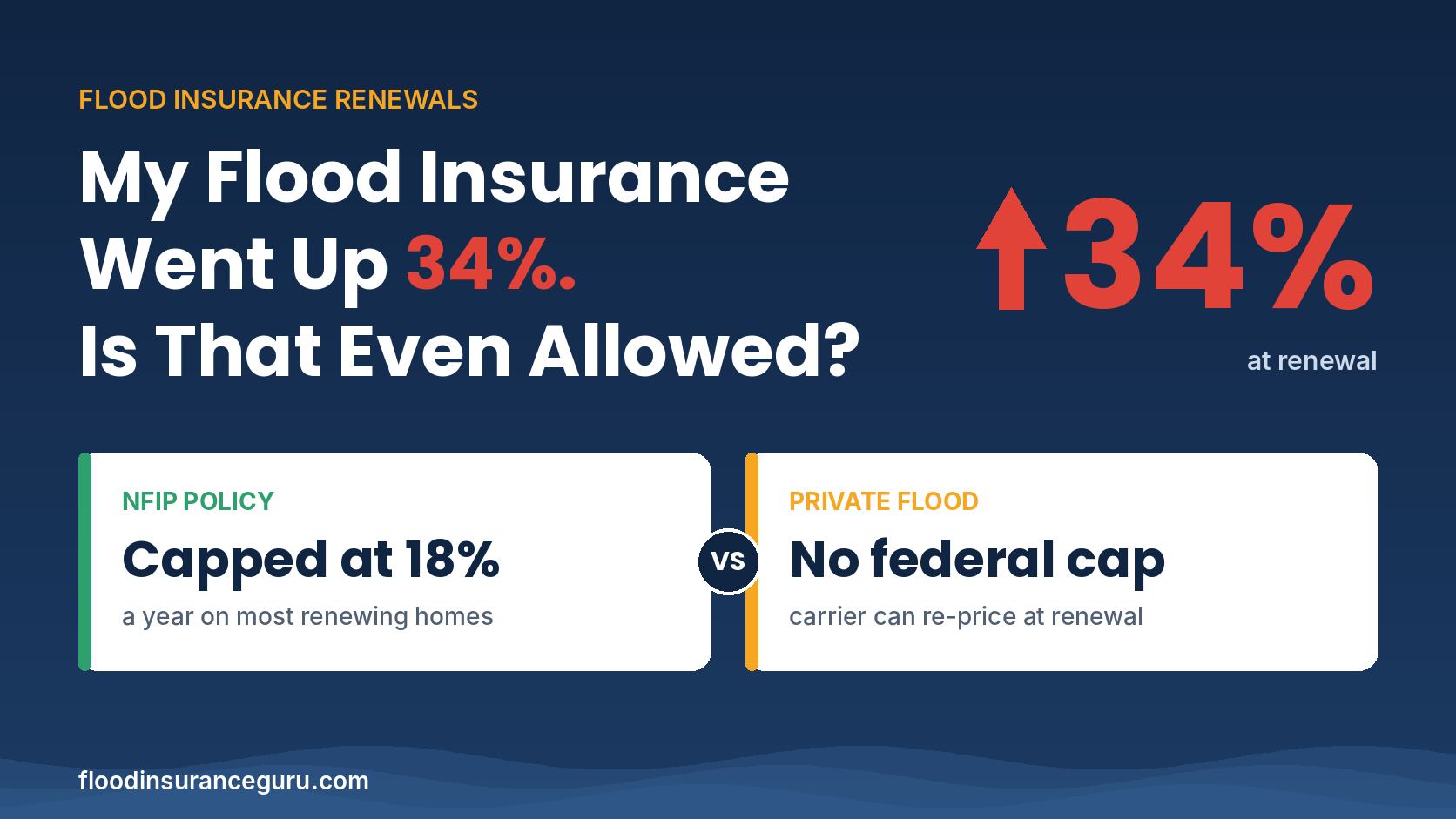
- You want predictable renewals. The NFIP can raise most primary home premiums by no more than 18% a year, according to FEMA. Here is how the 18% cap works. Private carriers have no such cap. Most of our Indiana private renewals barely moved, but some jumped more than 18% in a year.
- A private carrier will not take the home. Homes in or near a floodway, or with past flood losses, often get fewer private quotes. Private carriers can also cancel or decline to renew in ways the NFIP does not.
- You are thinking about leaving the NFIP and might come back. If you leave and later return, you can lose discounts you have today and pay the full risk price. Know that before you switch.
Wondering if you are paying too much? Enter your address and what you pay today in our free flood insurance price check. You will see how your premium compares with real quotes for similar homes near you.
What this means for your Indiana home
One quote is never enough. Carriers price the same Indiana house very differently, and the NFIP is not always the expensive option. The only way to know which one fits your home is to see both, side by side, with the same coverage. Our 7 steps for comparing flood quotes shows how.
That is what we do on every Indiana quote: the NFIP and private carriers together, with agency fees already included in the private numbers, and a straight answer about which one we would pick for your house.
Get your NFIP and private quotes side by side, or call 205-451-4294 to talk with a licensed flood advisor.
Want the regional detail? Start with our Indiana flood insurance cost page. Not sure which option fits your home? See the best flood insurance options for Indiana homeowners, and who each one fits.