

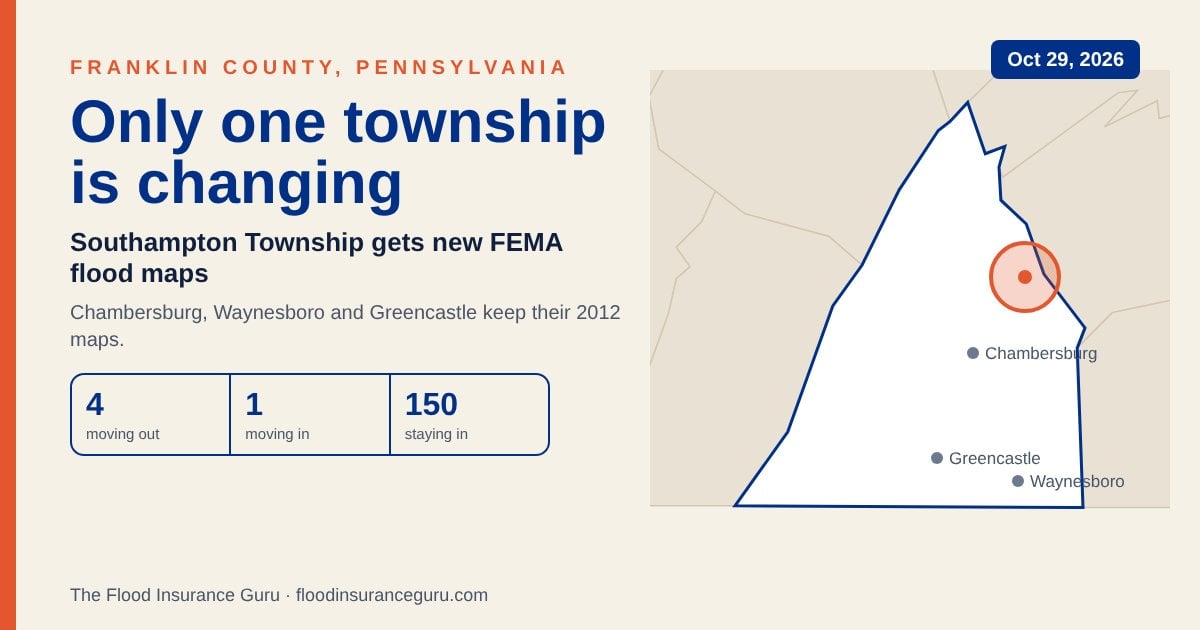
A narrow FEMA flood map revision takes effect in Franklin County, Pennsylvania on October 29, 2026, and it applies only to Southampton Township, along the Cumberland County line near Shippensburg. About 4 properties are expected to move out of the high-risk flood zone, 1 will move in, and 150 will stay in. Only 5 of the county's 118 map panels change.
Chambersburg, Waynesboro, Greencastle and the rest of Franklin County are not part of this revision, and their maps stay as they are. If you own, sell or lend on property in Southampton Township, the effective date is only days away, so check now.
At a glance
| Item | Figure |
|---|---|
| New maps take effect | October 29, 2026 |
| Current map date | January 18, 2012 |
| Map panels revised | 5 of 118 |
| Properties in the study area | 68,222 |
| Properties in the revised areas | 2,276 |
| Moving out of the high-risk zone | 4 |
| Moving into the high-risk zone | 1 |
| Staying in the high-risk zone | 150 |
| Share of all properties changing zone | 0.0% (less than one-tenth of 1%) |
| NFIP policies in force | 267 |
Figures are approximate estimates based on FEMA's Letter of Final Determination and parcel-level impact analysis, not official flood zone determinations for any single property.
Is your property affected? Check your flood zone in under a minute. The tool shows your current FEMA zone. The new maps for Southampton Township take effect October 29, 2026, so if your property is near a change area, call us at 205-451-4294 and we will walk you through what the update means for you.
The property count is countywide. The zone changes are confined to the revised panels in Southampton Township, which is why the county's overall impact rounds to zero.
Flood risk in Southampton Township
Southampton Township's mapped floodplain is shaped by small, spring-fed creeks rather than a big river. Middle Spring Creek, a tributary of Conodoguinet Creek, forms part of the township's boundary with Cumberland County, and Mains Run and Gum Run drain into the same system. Conodoguinet Creek carries water from the northeast part of Franklin County toward the Susquehanna. In cold winters, ice jams add another way for these creeks to back up.
Intense rain is the other threat. On June 8 and 9, 2015, three inches of rain fell in 30 minutes over neighboring Shippensburg, flooding streets, basements and businesses. Across Pennsylvania, the January 1996 floods showed what early ice jams plus rain can do, producing the worst flooding in some areas since 1955 or 1936.
This revision is FEMA project 23-03-0031S. The preliminary map, dated January 30, 2025, covers only Southampton Township, and FEMA invited public review in December 2025. Franklin County's current maps date to January 18, 2012.
The Good: 4 properties moving out of the high-risk zone
Only 4 properties will leave the Special Flood Hazard Area. If yours is one, your lender may be able to drop its flood insurance requirement after October 29, but it does not have to. Ask, and get the answer in writing before you change anything.
If you are released and carry an NFIP policy, you can cancel for a pro rata refund of the current term only; fees, surcharges and prior years are not refunded. Under Risk Rating 2.0, your premium usually will not drop just because the zone changed.
We would keep coverage. FEMA reports that one-third of NFIP claims from 2013 to 2023 came from outside high-risk flood areas. Being mapped out simply gives you the freedom to choose limits, deductible and carrier. Our Zone X guide explains the lower-risk side of the line.
The Bad: 1 property moving into the high-risk zone
Just 1 property is expected to be newly mapped into the high-risk zone. If it is yours and you have a mortgage from a federally regulated or federally backed lender, flood insurance becomes mandatory on October 29, 2026.
Your lender will send a notice, and you will have 45 days to show coverage before the lender force-places a policy and charges you for it, usually at a much higher price.
The Newly Mapped discount is designed for you. With a policy in effect within 12 months of the effective date, the first-year premium is 70% off for the first $35,000 of building coverage and the first $10,000 of contents coverage, and increases are then capped at 18% a year until the full-risk rate is reached. A lapse of more than 30 days forfeits the discount. Because the building is newly mapped in, a policy bought within 13 months of the effective date has a 1-day waiting period instead of 30. Buying before October 29 is fine as well.
The Ugly: 150 properties staying in the high-risk zone
The real weight of this revision falls on the 150 properties in the revised area that are in the high-risk zone and will remain there. The mandatory purchase requirement continues for mortgaged buildings.
The revised panels can still change base flood elevations and boundaries, which matter for new construction, additions, substantial improvements, and rebuilding after damage. In Pennsylvania, floodplain administration is municipal, so Southampton Township is the office to ask.
If you hold a Letter of Map Amendment (LOMA), check FEMA's LOMA Revalidation Letter: a LOMA can be valid, incorporated, or superseded, and a superseded LOMA must be refiled against the new map. If your structure sits above the new base flood elevation, a LOMA request to FEMA is free with elevation data from a licensed surveyor or engineer. An elevation certificate is optional for NFIP rating under Risk Rating 2.0 but can lower the premium and often helps with private carriers.
Basements are common in this part of Pennsylvania, and the 2015 storm in neighboring Shippensburg flooded basements there. The NFIP covers very little in a basement, mainly the foundation and certain essential equipment, and most private carriers also limit below-grade coverage. Ask exactly what is covered below grade when you set up your policy.
What to do before October 29, 2026
- Confirm whether your property is in Southampton Township. If it is not, this revision does not change your map.
- Check the address on the FEMA Flood Map Service Center or with our flood zone lookup guide.
- View the revised panels at the Southampton Township Municipal Building on Municipal Drive in Shippensburg.
- Ask your lender how it will apply the new map, in writing.
- If you are being mapped in, get NFIP and private quotes right away; the effective date is close.
- Agents and loan officers: verify the zone on any Southampton Township closing in late October or November.
- New to map changes? Read our guide to how flood map changes affect your flood insurance.
NFIP or private flood insurance in Franklin County
We place both NFIP and private flood insurance in Pennsylvania. NFIP residential limits are $250,000 for the building and $100,000 for contents. Private flood can provide higher limits, additional living expense, replacement cost options, and often shorter waiting periods, depending on the carrier.
Federally regulated lenders must accept private flood policies that meet the federal definition, effective July 1, 2019. FHA lenders may accept qualifying private flood since December 21, 2022, and USDA guaranteed loan lenders must accept it. Add contents coverage either way; for a primary residence, about 50 to 60% of the building coverage amount. Read about private flood insurance.
Frequently asked questions
Is all of Franklin County getting new flood maps?
No. Only Southampton Township is included, on 5 of the county's 118 panels. The rest of the county keeps its January 18, 2012 maps.
When does the Southampton Township change take effect?
October 29, 2026.
I'm staying in the high-risk zone. What can I do?
Get an elevation certificate. If your building sits above the new base flood elevation, you can request a free LOMA from FEMA. Even if it does not, the certificate can lower your NFIP premium.
Southampton Township's revised maps take effect October 29, 2026. Start by checking your flood zone, then request a free flood insurance quote or call 205-451-4294. Already insured? Have us review your current flood policy before the change.

Topics:


